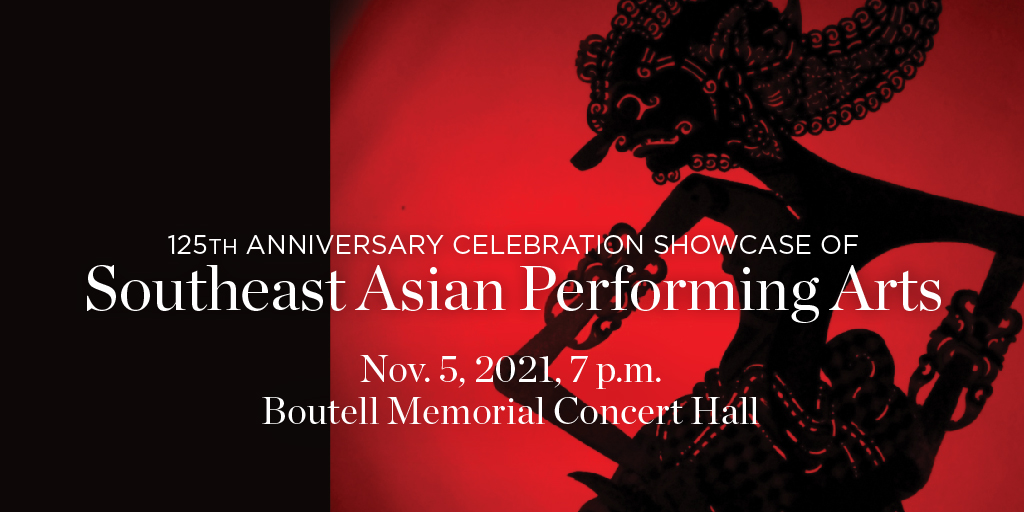
Chinese Music Ensemble Wei Yang and Jui-Ching Wang, directors
Japanese Music Ensemble Nan Yamprai, director
Music of East Asia Class Hyunchae Kim and Jui-Ching Wang, instructors
Special Guests Hong Da Chin, dizi Hyunchae Kim, gayageum Amely Zhou, erhu
Concert Program
Program
Korean Drumming Ensemble
Seoljanggu
Korean Pungmul
Chinese Music Ensemble
Jasmine in June
Taiwanese Folk Tune
Tea Picking
Taiwanese Hakka Mountain Song
Japanese Music Ensemble
Nihon no Warabe Uta
Traditional Japanese Nursery Rhyme
Kaze no Torimichi (The Path of the Wind)
Joe Hisaishi (b. 1950)
Gayageum Solo
Choi Ok-Sam School of Gayageum Sanjo Hyunchae Kim, gayageum; Suwan Choi, janggu
Music of East Asia Class
Purple Bamboo Flute Tune
Traditional Chinese Folk Tune arr. Kayla Bivin
Arriang Medley
Traditional Korean Folk Tunes
Korean Drumming Ensemble
Utdari Samulnori
Chinese Music Ensemble
Sounds of Falling Snow
Hu Lu (b. 1986) arr. J.C. Wang
The Little Village Story
C.S. Wong (1936-2012) arr. Y.F. W
Guest Performance Group
Run Together
Rae Lee (b. 1986)
Hong Da Chin (dizi), Suwan Choi (janggu), Hyunchae Kim (gayageum), Wei Yang (pipa), Amely Zhou (erhu)
Ensemble Information
Korean Drumming Ensemble
After a semester piloting the course in Spring 2021, NIU is proud to launch the first Korean Drumming Ensemble as the foundation to initiate a traditional Korean music program with the generous sponsorship from Korean National University of Arts in Seoul, South Korea and Korean Performing Arts Institute in Chicago (KAPC). Under the direction of master percussionist, Suwan Choi, the NIU Korean Drumming Ensemble teaches traditional Pungmul style and contemporary stage performance of Samulnori. This ensemble is open to all interested, no pre-music knowledge/skills required. For more information about this course, please contact director, Suwan Choi (suwan.choii@gmail.com).
Members Suwan Choi, Rowan Carter, Kacee Dugas, Fernando Marroquin Mendoza, Olive Wynn, Elizabeth Vieyra, Matthew Zelkowitz, Lydia Ziegler
Chinese Music Ensemble
The Chinese Music Ensemble was one of the first college Chinese music groups in the U.S. and currently is the only one in Illinois. Established by Professor Emeritus Kuo-Huang Han in the 1970s, it gave several national and international concert performances between 1976 and 1978. Members of the ensemble learn to play assorted authentic Chinese instruments.
Individual lessons and group rehearsals make up the major part of the curriculum, and Chinese musical instruments are available for short-term loan on a semester basis. In addition, members of the ensemble will also be introduced to basic Chinese music theory, the standard repertoire of Chinese instrumental and chamber music, and knowledge about performance practice along with the aesthetic values and symbolism of Chinese traditional music.
Members Dizi: Hong-Da Chin*, Elizabeth Vieyra Erhu: Kacee Dugas, Delaney Jacobi, Mei Lin McDermott, Gabriel Roethle, Jui-Ching Wang, Amely Zhou* Pipa: Quentin Dover*, Totus Tuus Keely, Felix Podschweit, Wei Yang Ruan: Brien Carney, Victor Wright Yangqin: Patcharita Pankaew Guzheng: Emma Bell, Aftyn Morris Cello: Zih-Cian Yu Percussion: Felix Podschweit
Japanese Music Ensemble
In Fall 2024, the NIU Japanese Music Ensemble is formed in the tradition of Sankyoku ensemble, which has its roots in the Edo period of Japan. The three instruments: koto (zither), shamisen (lute), and shakuhachi (bamboo flute) have great importance in Japan’s socio-cultural heritage. Continuing this tradition while embracing Japanese contemporary culture, students in the Japanese music ensemble engage in and learn not only from classical repertoires but also folk songs, theatrical arts, contemporary works, and popular music such as anime soundtrack.
Members Koto: Fernando Marroquin Mendoza, Patcharita Pankaew, Emma Bell, Silas Ashby Shamisen: Gabriel Roethle, Elizabeth Vieyra, Savannah Lisner-Johnson, Totus Tuus Keely, Sofia Diaz, Kacee Dugas, Zih-Cian Yu Shakuhachi: Nam Yamprai, Margaret Alway, Olive Wynn Shinobue: Jacob Seabrook Piano: Olive Wynn
Music of East Asia Class (Fall 2025)
A cross-cultural, comparative survey of both historical and recent developments in the music of East Asia, including the relationship of music to other aspects of East Asian cultures-philosophy, religion, theater, and dance, this course explores the diverse musical traditions of East Asia, focusing on China and Korea. Focusing on both historical and contemporary developments, this course also explores the relationship between East Asian music and other cultural aspects, such as philosophy, religion, politics, and other artistic genres including literature, theater, and dance. Music is approached as it is practiced, and as a lens for examining social and cultural forces that shape it. This course consists of two components, lectures and hands-on experiences, to allow students to apply what is learned in lectures in the actual musicking activities that take place on a weekly basis.
Members Kayla Bivin (clarinet), Sam Dion (ruan), Kacee Dugas (cello), Laura Gonzalez (violin), Jonluca Laporte (horn), Emvi Nullas Legaspi (vocal), Chenoa Randolph (vocal), Elizabeth Vieyra (dizi), with the assistance of Hyunchae
Tickets
Tickets for School of Music concerts are available online only. There are prices for adults, seniors, faculty and staff and non-NIU students. NIU students are admitted free of charge to all performances with pre-reserved tickets. Most recitals are not ticketed.
The NIU College of Visual and Performing arts puts on more than 200 live performances and exhibitions every year. See what’s coming up next in the School of Music, School of Art and Design, School of Theatre and Dance and the NIU Art Museum.
The renowned World Music program at NIU is what drew Chih-I Hsaio to DeKalb after earning his degree in Music Theory of Taiwanese traditional music at the Taipei National University of the Arts.
He chose to earn a Master of Music in World Music at NIU. “I have had a strong interest in exploring music from different cultures around the world,” Tsaio said. ” With what I have learned so far, I learn that the world of music is actually far wider and more diverse than I thought before and that if I want to keep learning more about various musical cultures, I must have an open mind that eliminates to a great extent my bias and prejudice that came as part of my pre-knowledge. I have found studying world music fascinating and engaging. I look forward to sharing what I have learned in this program with more people.”
Chih-I made the most of his time at NIU. He served as graduate assistant for the Asian American Studies Certificate program, president of the World Music Club and vice president of the Taiwanese Students Association.
“The NIU World Music program is one of the best world music programs in the world,” Hsiao said. “As a non-western classical trained musician, I think the world music program at NIU has the best graduate program that allows students to explore the studies of various world music cultures and tie these closely together with our career path.”
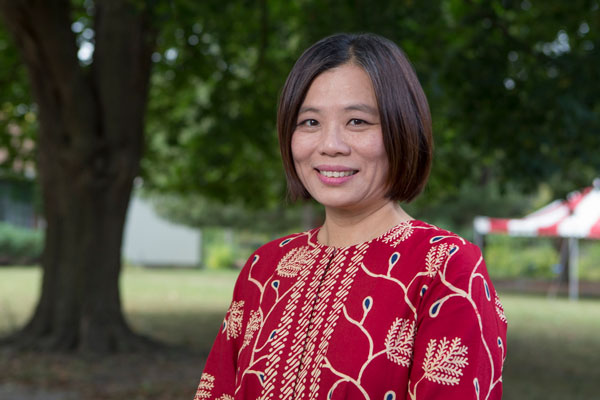
Faculty Huskie Spotlight: Jui-Ching Wang, Professor of World Music
What year did you start working at NIU? I started working at NIU in 2004 when I was still an ABD (all but dissertation).
Where is your hometown? Where do you live now? I grew up in a small town nearby Hsinchu City in Taiwan. I live in DeKalb now.
Where did you attend college and what degree(s) have you earned? I attended the music department at Soochow University in Taipei, where I received my BFA degree in music in 1993. I came to NIU as a graduate student in 1995 and earned two Master of Music degrees, one in Piano Performance (1997) and the other in Music Education (1998). I went on to pursue doctoral study in music education at Arizona State University, and I received my doctoral degree in 2007.
What do you like about working at NIU? NIU has most of the resources I need to develop my career in higher education. The support I’ve received from professional staff, administrators, and my colleagues who I have worked with is beyond my expectation. I’ve also had many opportunities to work with serious learners, both graduate and undergraduate students, to help them develop their career, which is absolutely rewarding throughout my time here.
What advice would you give to students currently attending NIU? Take advantage of what the faculty can offer. Challenge the faculty in a positive way! For me, teaching is learning, and I am all about embracing challenges from my students because I believe that each of my students is unique, and it will keep me motivated and wanting to learn more from each of them.
Tell us about a research or engaged learning project you have led. I am interested in children’s singing games and am intrigued by how effectively children learn from each other in play. I have conducted several research projects, including one sponsored by the Fullbright Foundation in 2016-17, to study Javanese children’s singing games in various historical contexts. Specifically, I look into the sociocultural functions these singing games play in child development in Indonesia. I plan to expand this project to study singing games of various Asian cultures, such as Japan, Korea, Taiwan, Thailand, and Vietnam.
What do you hope students take away from your class? What I want for my students to take away from my class is a learning habit that allows and motivates them to learn anywhere and anytime. What I teach content-wise in the classroom setting is limited, so I am always hopeful that my students will learn beyond the course materials and will transcend their learning to a higher level where they would become their own teacher to improve themselves day after day even after they are done with school.
What is your favorite campus event? I enjoy most attending School of Music concerts. Sometimes I go watch football or basketball games. I would also attend cultural events, such as Southeast Asian Cultural Night.
What is your favorite memory of NIU? Going to football games with my students. Seeing many of my students play in the Huskie Marching Band always excites me! Hosting many concerts and world music festivals in the School of Music is always a fond memory as well!
Who has influenced your professional path? Dr. Kuo-Huang Han, my predecessor, was always there when I needed his guidance in getting myself ready to teach at NIU when I first started here in 2004.
What did you want to be when you were growing up? Are you currently doing it? If not, what changed your path? I was hoping that I would become a diplomat because when I was younger, I always dreamed about traveling around the world as a grown-up, and I really enjoy learning different cultures somewhere out there. Although I did not pursue this “dream job,” I have managed my study and my career so that I can constantly learn something new about world cultures and can travel as much as I could as an academic. Being able to promote cultural understanding through music, which is a big part of my job, makes me feel that I am somewhat a cultural ambassador as well.
Are you a member of or hold a position within a professional organization? If so, what organization? What is the purpose of that organization and how does being part of this organization benefit you in your role at NIU? I am a member of several important professional organizations in ethnomusicology and music education, such as the Society for Ethnomusicology (SEM), International Council for Traditional Music (ICTM), International Society for Music Education (ISME), and National Association for Music Education (NAfME). The primary purpose of these organizations is to network with other academics like me and to improve myself to be up to date in teaching and scholarship.
In addition to being a member, I currently serve on the Editorial Board for ISME’s International Journal of Music Education, and am on the Advisory Board for NAfME’s Music Educators Journal. I review approximately six to eight manuscripts annually for them. Through this process, I make myself familiar with current research and practical trends in music education not only in the U.S. but also the world.
I think being part of the organizations and holding a position within them helps me to demonstrate to our students that learning and teaching are a life-long process and that there are always people out there that you can benefit from if you are willing to learn.
What do you do to relax or recharge? I travel a lot during breaks, and sometimes I would align the trip with professional engagements. Being able to visit different places and people always gives me “fresh air” that is so enjoyable! And I go to the movies often to indulge myself at a space and time that would take me out of my work routine. A two-hour treat to allow my imagination to go wild is an effective way to recharge.
Music Huskie SpotlightFaculty Huskie Spotlight: Greg Beyer, Professor and Director of Percussion StudiesWhat year did you start working at NIU? 2004. Where is your hometown, and where do you live now?I grew up in Janesville, Wis., and I live in DeKalb now. My folks...
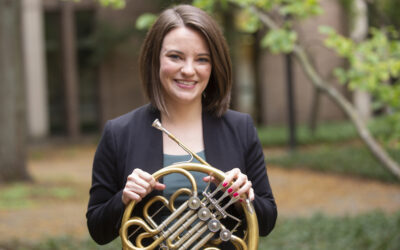
Music Huskie SpotlightFaculty Huskie Spotlight: Renée Vogen, Instructor of Horn What year did you start working at NIU? 2021Where is your hometown? Manhattan, Ill.Where do you live now? ChicagoWhere did you attend college and what degree(s) have you received? MM,...
There is no charge for admission, audience members are encouraged to consider donating to a Ukraine aid organization such as:
Mercy Corps – Provides humanitarian assistance, cash aid, and works with local organizations in Ukraine to get funds and donations to places they’re most needed.
United Nations High Commission for Refugees – Provides resources and aid for refugees, displaces people, and those removed from their homelands. Currently working to provide support for Ukranians fleeing their country.
Direct Relief – Provides medical supplies, currently working with the Ukranian Ministry of Health, and is working to offer medical aid to people in Ukraine and the surrounding countries.
Save the Children – Helps families and children in a variety of ways, offering cash assistance, shelter, food, education and much more to provide humanitarian support to the people of Ukraine. This organization focuses its efforts on children and families with children affected by the crisis.
The benefit concert has been organized by a pair of graduate students in the NIU School of Music, Jennalynn Cisna and Annie Sun Chung.
Ukraine Benefit Concert NIU School of Music Boutell Memorial Concert Hall Friday, March 25, 8 p.m.
Program Order
Ukraine National Anthem, United Armed Forces edition
Collaborate performance of strings and winds
Annie S. Chung, conductor
Drastic Measures, Mvt. I, Russell Peck (1945-2009)
Nick Haddock, Daniël Smith, David Patush, and Aaron Adams
Saxophone Quartet
Berimbau Solo no. 4, “Sakura Park” Traditional Music from Capoeira Angola Ladainha, “eu ’tava em casa”
as recorded by Mestre Traíra (b. 1963) andtranscribed by Gregory Beyer
Dr. Gregory Beyer, berimbau
Elegiac Trio, Arnold Bax (1883-1953)
Gianna Capobianco, flute; Zachary Green, viola; Abby Stoner, harp
Caritas, Mvt. II ‘Solemn’ Michael Burritt (b. 1962)
Matt Schneider, Marimba
Plyve Kacha, Ukraine Folk Song arr. Andrew Selig (b. 1997)
Andrew Selig, Sergio Arias-Montiel, Liam Weber, and Ting-Yun (Rebecca) Wu
Horn Quartet
Romanze in F minor, Op. 60, Ludwig van Beethoven (1770-1827)
Ranan Antonini, violin; Jennalynn Cisna, piano
Mariel, Osvaldo Golijov (b. 1960)
Ben Heppner, Marimba; Dayoung Park, cello
Tomorrow Will Be a Better Day, Da Yo Lo (b. 1954)
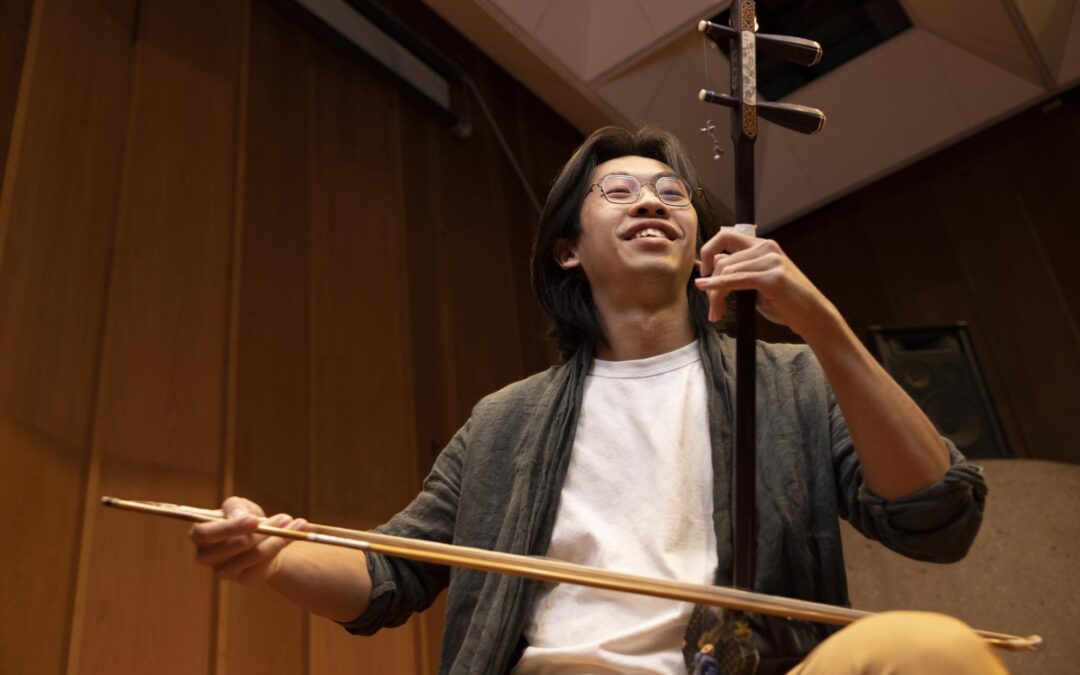
Chih-I Hsiao, Erhu
Ting-Yun (Rebecca) Wu, Piano