Apr 30, 2026 | Art and Design, xArt and Design News, xCVPA, xFeatured
When Kelly Gross, assistant professor of visual arts education at NIU received a grant from the NIU Student Engagement Fund for a study into the use of artificial intelligence, she knew which students of hers would be perfect for it.
She approached Lane Staffeldt and Evie Mulcahey, visual arts education majors who had worked with her on a project in her art and technology course to earn honors credit. She had connected them with Casey Macko, an art teacher in at St. Charles North to conduct some interviews on how he was using AI in his classes.
Under Gross’ mentorship, Staffeldt and Mulcahey have taken different, but parallel approaches to their research project on how high school teachers are approaching the use of AI in their classes. Staffeldt has done individual interviews, while Mulcahey has done focus groups.
Mulcahey said that in the focus groups she has found that art teachers focused on technology are more skeptical about how effectively students can use AI than teachers who are focused on fine, or studio art.
“The studio art teachers didn’t seem to have fully grasped how to use AI in their classes,” Mulcahey said. “The art technology teachers understand AI better, and they have more concerns about ways it could be used wrong. But it’s understandable, because it’s harder to use AI if you are doing something physically like painting, as opposed to something digital like animation or a photograph.”
Staffeldt is particularly interested in the ethics, bias and environmental impact of AI, something that has come out in the interviews as well. “In our classes we have been discussing what does AI in an art classroom look like? We are exploring where the line is. So, in the research interviews, it was good to hear about the ways teachers are talking about it with students, because students are really starting to use it all the time now.”
Mulcahey and Staffeldt had the opportunity, along with Gross, to present their initial findings at the National Art Educators Association national conference in Chicago in February.
“It was a great opportunity for them,” Gross said. “The NAEA Conference drew 6,000 art educators from around the country, and we presented to a very engaged crowd of about 45 in our session.”
Staffeldt said that presenting at NAEA was “Terrifying, but awesome.”
Mulcahey was excited to see the interest teachers had in their topic. “It was a good range of people,” she said. “There were a lot of great questions. It really got us thinking more deeply about what kinds of questions we still needed to find answers to.”
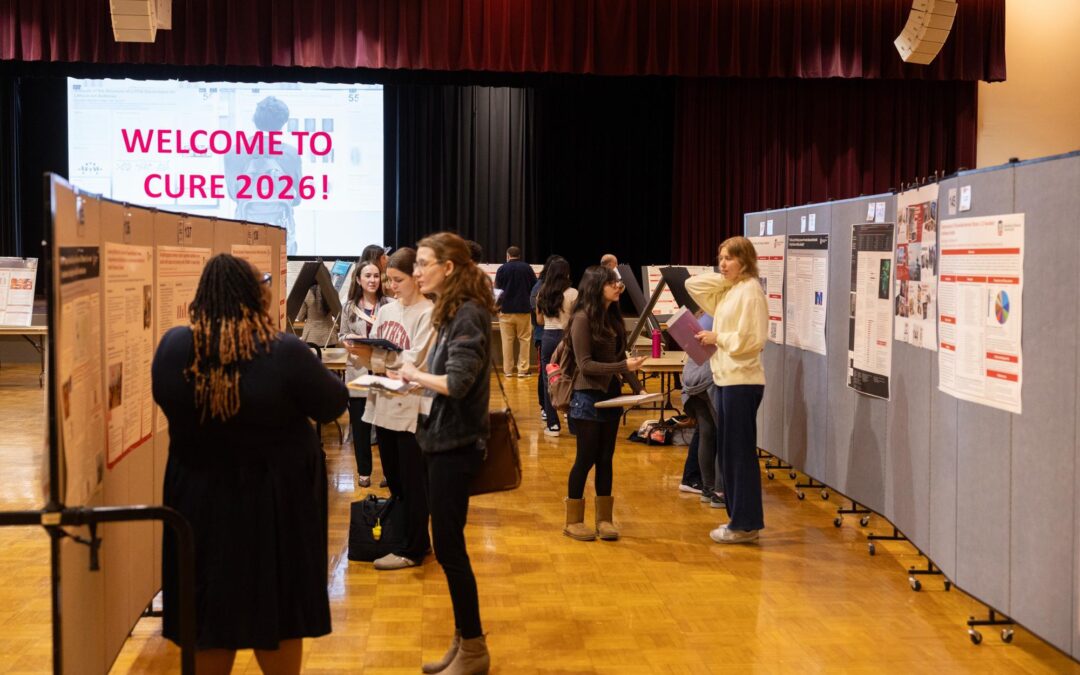
The pair presented at NIU’s CURE Conference on April 28.
“Lane and Evie have been great to work with,” Gross said. “They are very motivated students, and have become more and more interested in their subject as they’ve done the research. They are very well prepared. Sometimes more prepared than I am.”

Mar 4, 2026 | Art and Design, xArt and Design News, xCVPA, xFeatured
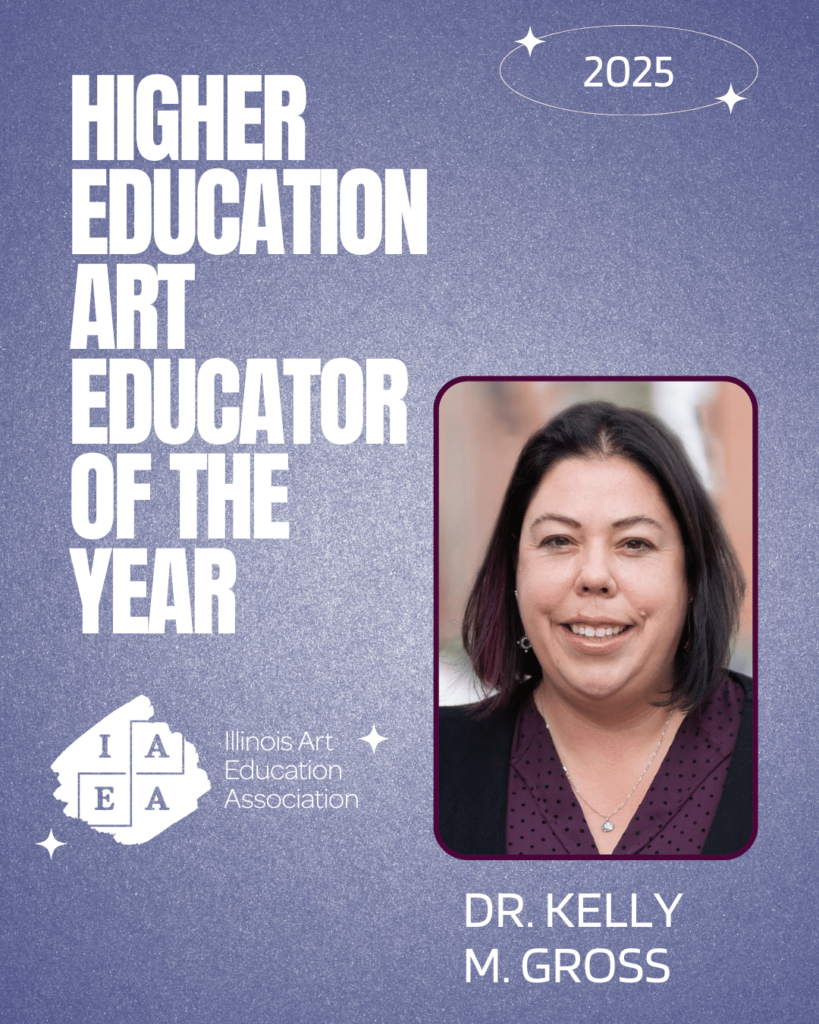 Kelly Gross, Ph.D., assistant professor of art and design education in the NIU School of Art and Design has been named the 2025-2026 Higher Education Art Educator of the Year by the Illinois Art Education Association (IAEA). Gross was honored at their annual conference in Schaumburg.
“I sometimes joke that I’m an educator at heart and an art educator second,” Gross said. “I have a long history of working with different populations of students. I’ve always worked in public schools, starting in New Orleans and New York City, and I worked at a charter school in Chicago. The world is a place of right and wrong. You get an answer correct on a test, right? Art is a place of possibilities in which there are multiple right answers, and multiple ways of being and doing.”
Gross says the makeup of the student body at NIU is what drew her back.
“I love the diversity of our student body,” she said. “I love that we are a Hispanic Serving Institution. I have a strong desire to work in urban areas because that’s where my personal history is. We have students coming to us from Chicago and Rockford, and that’s something I feel deeply committed to. Also, part of my reason for wanting to work here is to work with masters and doctoral students. One of the joys at being at NIU is the ability to mentor doctoral students, they’re the next generation.”
Her first doctoral advisee Emma Coker graduated in December. “Emma started with me as a research assistant,” Gross said. “With a grant that I received from the National Arts Education Foundation. I co-chaired her dissertation with Kerry Freedman (professor of art and design education at NIU) and we presented all over the world together. Eva and I presented in Cambridge, England. It’s been a true mentorship, and a joy. I grew so much as a doctoral student under the mentorship of Dr. Freedman, Dr. (Douglas) Boughton, and Dr. (Kryssi) Staikidis, myself, that it was important to me to be able to have that opportunity.”
Gross has been at NIU as a full-time tenure track faculty member since 2020. She earned her Ph.D. in art and design education from NIU in 2017, and has previous higher education teaching experience at Vermont College of Fine Arts, Illinois State University and The School of the Art Institute of Chicago.
In addition to her Ph.D. from NIU, Gross holds a master of arts in art teacher education from New York University, and a bachelor of fine arts in industrial design from Carnegie Mellon University.
She is especially proud to be honored by IAEA, as she considers their conferences to be an important part of her continuing education in the field, and a chance to demonstrate its importance to her own students.
“I continue to do research and publish at the national and international levels, but I make a point to always attend the Illinois conference,” Gross said. “For the past couple of years I’ve been bringing groups of students, and present with them. These are often undergraduate students, and I get to provide guidance and support as they often present on teaching experiences here in our city and on campus. It’s a good way to encourage a new generation of students to be involved with a professional organization.”
At the 2025 IAEA Conference, Gross and her students gave the presentation, “Finding My Voice” which detailed their experiences establishing and teaching a curriculum on digital art for students involved in the Barb City STEAM Team afterschool program. The program is free for middle school students in DeKalb and presented by NIU STEAM.
“Each semester our art education students develop a series of lessons and offer them every Tuesday and Thursday for several weeks. It is part of my Art and Technology course, and “Finding My Voice” included lessons on podcasting, stop motion, digital photography and others. It’s a way of engaging in digital art technology in a community-based setting. It’s really nice that through this partnership our students get a chance to experience that.”
Nov 15, 2021 | Art and Design, xArt and Design News, xCVPA, xFeatured
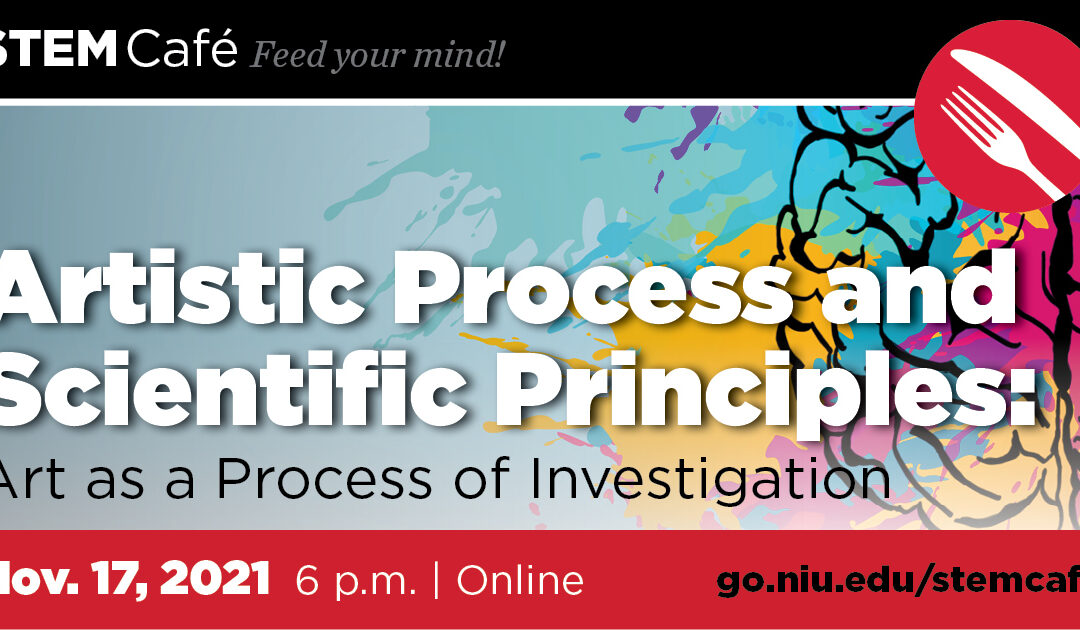
We often think of art and science as very different processes. But for Kelly Gross and Jolien Genus, art and science share the same processes of investigation, research and relationship building. At the next STEM Café, hear from these two artists and educators about how they engage in hypothesizing, documentation and interpreting scientific principles in the art-making process.
“Artistic Process and Scientific Principles: Art as a Process of Investigation” is an online lecture held, Wednesday, November 17 at 6 p.m. online. You can register at go.niu.edu/stemcafe.
Learn about Gross’s artist residency at the DuPage Children’s Museum, where she investigated projects with children exploring light, shadow and storytelling. Hear about Genus’s artistic evolution from graduate school to the Peace Corps and Hawaii. His artworks investigate the relationship between painting and STEM and the relationship between art and the social work theory of Person in Environment.
Kelly Gross, Ph.D. is an Assistant Professor in Art and Design Education at NIU. Joelouie (Jolien Genus), MFA, MSW is an artist and STEAM teacher based in Oahu, Hawaii.
Registration is required for this free online event. Register and learn more at go.niu.edu/stemcafe.
Apr 23, 2021 | CVPA, Music News, xArt and Design News, xCVPA, xFeatured
Every year seniors in NIU’s College of Engineering and Engineering Technology engage in a year-long design project that involves creating or improving commercial products or industrial processes. They are mentored by faculty and industry professionals to get hands-on, real-world experience. This year, three of those projects were the result of proposals written by College of Visual and Performance Art faculty who then served as project mentors.
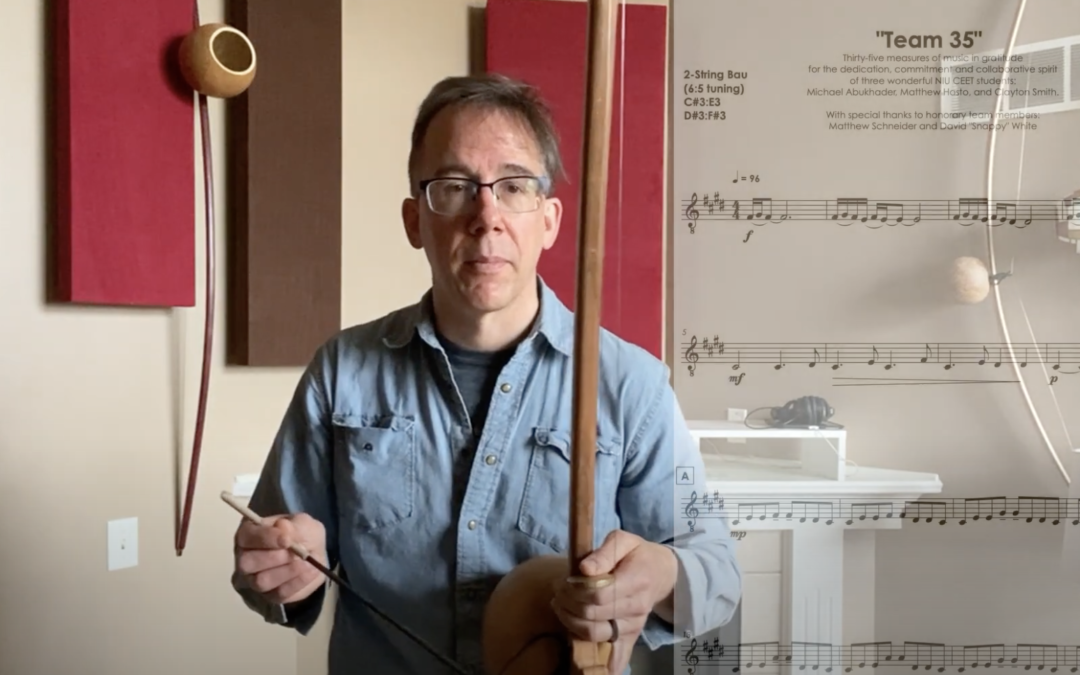
Gregory Beyer, professor of music and director of percussion studies worked with “Team 35” as they designed a berimbau, an Afro-Brazilian percussion instrument, traditionally made with one string.
Yuko Asada, musical instrument technician, assistant director of the NIU Steelband and director of the Community School of the Arts Steelband worked with “Team 51” as they sought to create a method to mechanically forge the construction fo the steelpan, a process that when done manually can be physically taxing.
Kelly Gross, instructor in the Art Education department in Disability Studies and Technology, mentored “Team 44” on creating a photography system for persons with physical differences.
Design of Berimbau Instrument
“I am delighted to report that the year of work in pursuit of developing a two-string model of an Afro-Brazilian berimbau, a traditional one-string musical bow, has produced remarkable results,” Beyer said. “Not only have we created an instrument that allows one performer access to a wider and more complete compass of pitches, we have also developed an instrument with a unique timbral profile.”
Team 35 was made up of CEET seniors Michael Joseph Abukhader, Matthew J Hasto, and Clayton Lee Smith.
Mechanical Forging for the Construction of a Standardized Steelpan Instrument
Part of NIU’s world-renowned Steelpan Studies program involves the actual building of the instrument, and Yuko Asada sought help from Engineering to help automate the process. “Steelpans are all hand made,” she said. “The most high tech tools we use are pneumatic hammers. It takes a long time for us to create steelpans, and it also causes a lot of strain on the wrists, hands, arms, really the entire body to make them. An automated process would make it faster and easier, and it would also cut down the time that we’re exposed to the noise and vibration as we make them.”
The design team created a machine that used an increment forming process to build one of the small pans. Asada was pleased by the results, though the process still needs some fine “tuning.”
“The issue we encountered is that each note isn’t isolated, so when you strike a note the surrounding area rings,” she said. “So there are some things that can be improved, but as a first step it’s very exciting.” She said she hopes next year another senior design project team will take on the next step in the process to get closer to the long-term goal of being able to mass produce steelpans which will allow us builders to concentrate on tuning the instrument.
Asada said she was very impressed by the knowledge of the Engineering students and how easy they were to work with. “Being able to work with students from another college and work with those who have the knowledge I don’t have was something I really enjoyed.”
Team 51 was made up of CEET seniors Gabriel Gandara, Nicholas Grimes, and Josefina Buan.
Photography System for Persons with Physical Differences
Gross submitted a proposal for a senior design project to create an adaptive tripod for wheelchair users. Gross helped set up interviews with the design team and wheelchair users to provide specifics about the factors to consider in developing a tripod that meets the users exact needs.
She worked to familiarize the design team with the kinds of equipment the photographers would be using and the challenges that issues with lack of hand strength or range of motion provide and would need to be factored into the design. The design team used all of that information to create a prototype mount for a tripod controlled by a remote.
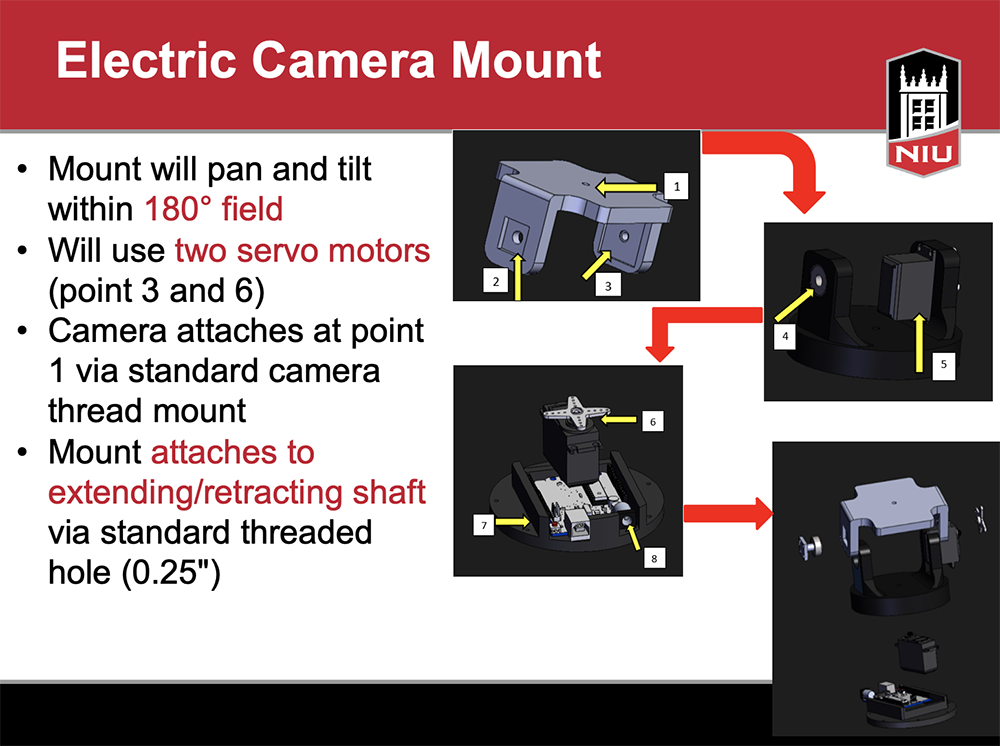
Gross said the next step in the process will be to create functionality to control the tripod’s movements through a phone app instead, similar to the way users are able to control their DSLR phones.
“One of my goals with this project, which was met was to open their minds in terms of engineering in terms of accessibility,” she said. “The conversations they had with wheelchair users and people with physical disabilities really helped them understand limitations. In terms of moving forward as engineers and thinking of accessibility in the arts and in all aspects of life, I think the project was really successful.”
Team 44 was made up of CEET seniors Daniel Avila, Daisy Hernandez, and Malak Zayed.