Upcoming Winds concert featured on WREX-TV

Upcoming Winds concert featured on WREX-TV

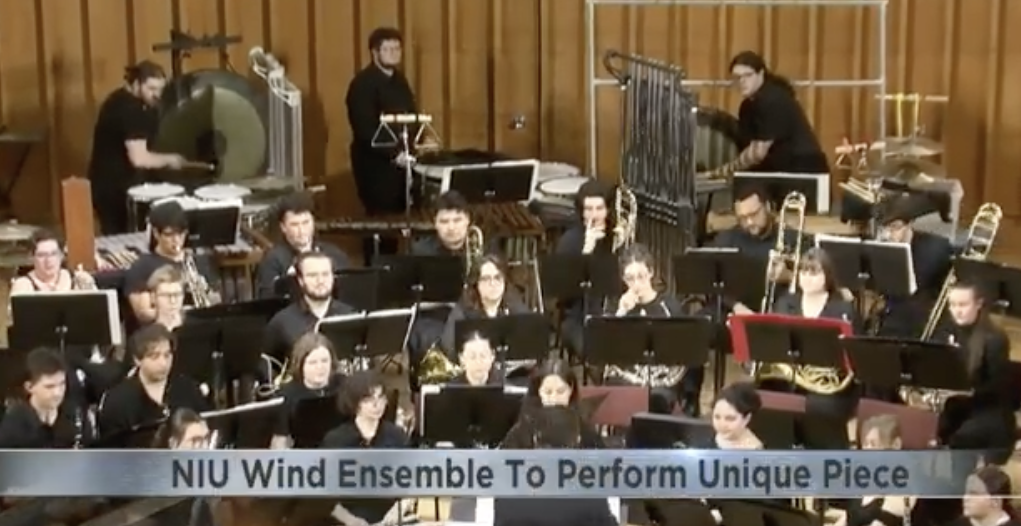
On Friday night, April 17 at 7 p.m. the combined NIU Wind Ensemble and NIU Wind Symphony will perform in concert in Boutell Memorial Concert Hall in the NIU Music Building. One of the pieces they will be performing is famous for being a little unconventional. NIU Professor of Music and Director of NIU Band, Tom Bough was featured on Rockford’s NBC affiliate WREX to discuss the challenges of playing and conducting Joseph Schwantner’s “…and the mountains rising nowhere.”

Tickets are available for the concert at go.niu.edu/arts-tickets. NIU students are admitted free of charge with a reserved ticket.


April 17 – NIU Wind Ensemble and Wind Symphony

April 17 – NIU Wind Ensemble and Wind Symphony

Concert Program

Large Ensemble Concert Series

NIU Wind Ensemble and Wind Symphony

Tom Bough, Conductor
Alex Harrington, Graduate Assistant

Friday, April 17, 2026
7:00 p.m.
Boutell Memorial Concert Hall


Of Endless Miles and Empty Rafts, Michele Fernandez (b. 1965)

Alex Harrington, Conductor 

Throughout time and regardless of origin, immigrants have shown a spiritual courage and resolve to survive that has found countless families suffering perilous journeys in search of safety. Many have been lost along the way. As a child of Cuban parents who fled oppression (leaving much behind to build a new life), my respect and empathy for all immigrants runs deep. Although my parents’ (still traumatic) exoduses were not by sea, several family members’ and friends’ journeys were. Throughout my life I have heard stories of near losses and rafts washing ashore, empty. I still recall the feelings since childhood — wondering who they were, and what happened to them.

The piece is written using two authentic Afro-Cuban forms: Guaguancó and Son-Montuno. In this work, many authentic patterns are woven into the fabric of the winds as well. No prior knowledge of Afro-Latin forms is needed to achieve an authentic performance, as percussion parts are carefully crafted using a personally developed, simplified method to achieve authenticity quickly. Each brief section represents elements of an immigrant’s story.

–           Program notes from the composer

Ghost Train, Eric Whitacre (b. 1970)

This piece is the first movement of a three-movement collection depicting a supernatural train moving through abandoned towns and empty canyons during the night. You can hear odes to train whistles, roaring engines, and a moving rhythmic line to showcase the train’s speed and power. This piece is rooted in American folklore and had its first movement premiered in the spring of 1994, which, was initially the only movement included in the work. The following movements were added later and premiered in 1995 along with the first movement.

Chorale and Alleluia, Howard Hanson (1896-1981)

Alex Harrington, Conductor

Chorale and Alleluia was completed in January 1954, and was Dr. Hanson’s first work for symphonic band. It was given its premiere on February 26th at the convention of the American Bandmasters Association at West Point with Colonel William Santelmann, leader of the U.S. Marine Band, conducting.

The composition opens with a fine flowing chorale. Soon the joyous Alleluia theme appears and is much in evidence throughout. A bold statement of a new melody makes its appearance in lower brasses in combination with the above themes. The effect is one of cathedral bells, religious exaltation, solemnity, and dignity. The music is impressive, straightforward, and pleasingly non-dissonant, and its resonance and sonority are ideally suited to the medium of the modern symphonic band.

– Program Note provided by Carl Fischer Music

National Emblem March, Edwin E. Bagley (1857-1922), arr. Schissel

Featuring the combined trombone sections of the Wind Symphony
Alex Harrington, Conductor

National Emblem March was written by E.E. Bagley in 1905. Considered one of the finest marches ever written, this march has had a wide exposure of performance throughout the world. Bagley includes melodies from The Star Spangled Banner in the first strain and trio and was also inspired by herds of buffalo to create the heavy and repetitive beats heard in the trio. Frederick Fennell considers this march as “perfect a march as a march can be” and was highly regarded by John Philip Sousa, making his list of best parade marches. This piece has 14 different arrangements includes those for band and orchestra.

INTERMISSION
...and the mountains rising nowhere, Joseph Schwantner (b. 1963)

…and the mountains rising nowhere holds a unique place in the repertoire for wind bands. It is scored for an extended orchestral wind section, percussionists who are responsible for 46 different instruments in the course of the piece, and amplified piano. In addition to all of the effects that Schwantner achieves with his percussion menagerie and conventional piano and wind sounds, he calls for unusual techniques in the winds such as singing, whistling, aleatoric effects, and even tuned glasses which the saxophone and euphonium sections play for more than half of the piece. These combine to make a mystical soundscape unlike anything that has come before or since. Composed in three large sections, …and the mountains rising nowhere utilizes seven as a generative tool: the amount of lines in the poem, seven-note chords, groups of whistlers, and the tonal centers are even related by an interval of a diminished-seventh. He incorporates contrast by juxtaposing seven-note scales with eight-note scales. This results in a piece that bears a tonal center in a different sense than Bach or Mozart would.

Commissioned by Donald Hunsberger and the Eastman Wind Ensemble with a grant from the National Endowment for the Arts, …and the mountains rising nowhere was Joseph Schwantner’s first composition for wind ensemble (and is part of a “trilogy” that includes From a Dark Millennium and In evening’s stillness). The premiere was given in College Park, Maryland, at the 1977 National Conference of the College Band Directors National Association (CBDNA) by the Eastman Wind Ensemble, Hunsberger conducting. It is dedicated to children’s author Carol Adler; its title inspired by a line in her poem Arioso:

arioso bells
sepia
moon-beams
an afternoon sun blanked by rain
and the mountains rising nowhere
the sound returns
the sound and the silence chimes

Program notes from the Wind Repertory Project

Against the gusts of blank repose, a threshold that persists, Joseph Klein (b. 1962)

Joseph Klein (b. 1962, Los Angeles, Calif.) is an American composer and music educator.

Dr. Klein holds degrees in composition from Indiana University (DM, 1991), University of California, San Diego (MA, 1986), and California State Polytechnic University, Pomona (BA, 1984), where his composition teachers included Harvey Sollberger, Claude Baker, Robert Erickson, and Roger Reynolds.

Klein is a composer of solo, chamber, and large ensemble works, including instrumental, vocal, electroacoustic, and intermedia compositions. His music reflects an ongoing interest in processes drawn from such sources as fractal geometry, chaos, and systems theory, often inspired by natural phenomena. His works frequently incorporate theatrical elements, either as an extension of the extra-musical references or as an organic expression of the musical narrative itself. Literature is another important influence on his work, with recent compositions based on the writings of Franz Kafka, Elias Canetti, Alice Fulton, W.S. Merwin, Milan Kundera, and John Ashbery.

He writes: “Against the gusts of blank repose, a threshold that persists” is dedicated to the memory of my son, Gabriel Paul Klein, who took his in life September 2015 at the age of 23. The work’s title is derived from two lines in Alice Fulton’s poem “Silencer”, from the collection “Powers of Congress) – a poem that itself deals with the subject of suicide–and is an allusion to the persistent struggle with that boundary between life and death (“blank repose”).

The work is characterized by sharp juxtapositions of contrasting—often conflicting—musical elements, including sections of restless energy, obsessive ostinato figures, and intrusive interjections, occasionally relieved by stretches of placid, suspended music. The disjunct, fragmentary structure that results, combined with the inherently static, non-developmental nature of the material itself, is intended to subvert the typical linear narrative. An important unifying element of the work is the pitch cell G-A-Bb-E, which is the basis of a repeating interval sequence used to generate the symmetrical, non-octave-repeating scale that is used pervasively throughout the work. This scale is most clearly presented in the ascending quasi-ostinato bass line that first occurs after the slow introductory section. Prime numbers and rhythmic patterns based on Morse Code are also used as unifying structural elements.

Against the gusts of blank repose, a threshold that persists, originally composed for wind orchestra, was completed in September 2016.

Strange Humors, John Mackey (b. 1973)

Alex Harrington, Conductor

Strange Humors represents another of Mackey’s works (after “Redline Tango”) that has been transcribed for wind ensemble. The first version of “Strange Humors” was a student piece for string quartet and djembe that Mackey wrote while pursuing his graduate degree at The Juilliard School. It was later adapted for use by the Parsons Dance Company, with choreography by Robert Battle. Its transcription came at the behest of Richard Floyd on behalf of the American Bandmasters Association. The piece represents a merging of musical cultures — the modal melodies and syncopated rhythms of middle Eastern music with the percussive accompaniment of African drumming.

At the heart of the work lies the pulse of the djembe, which remains from the original version. The djembe, an hourglass-shaped drum played with bare hands, is a major part of the customs of west African countries such as Mali and Guinea, where djembe ensembles accompany many functional celebrations of society.

The piece opens with a sultry English horn solo, a line laced with Phrygian influence representing the “typical” melodies of the most northeastern parts of the African continent — most notably Egypt, but also parts of the Arabian peninsula. Later, the saxophones emulate the snaking lines of the English horn. The addition of brass and auxiliary percussion to the original orchestration makes for particular impact during the shout sections of the piece, and the groove of the djembe combined with the quirky rhythms throughout leave an impression that lingers in the listener’s mind long after its conclusion.

Program note by Jake Wallace

Irish Tune from County Derry, Percy Grainger (1882-1961), ed. Mark Rogers

Irish Tune from County Derry is among the most beloved of Grainger’s many folk song settings for wind band. During the course of his career, he produced multiple arrangements of this song, including versions for mixed chorus, solo piano, string orchestra, and symphony orchestra. This setting for military band (as opposed to the all-brass bands common in much of Western Europe when this music was written) was one of Grainger’s first contributions to concert band literature. Mark Rogers, the head editor for band music at Southern Music Company, produced this edition to better fit modern wind band instrumentation and to remove the dozens of errors present in the earlier sets of parts. In particular, he retained the use of the soprano saxophone, one of Grainger’s favorite instruments. The lyrics of the song belie the emotion and drama contained within the music:

O Danny Boy, the pipes, the pipes are calling
From glen to glen, and down the mountainside
The summer’s gone, and all the flowers are dying
‘tis you must go, and I must bide

But come ye back, when summer’s in the meadow
Or when the valley’s hushed and white with snow
And I’ll be there, in sunshine or in shadow
O Danny Boy, O Danny boy, I love you so.

 And if you come, when all the flowers are dying
And I am dead, as dead I well may be
You’ll come and find the place where I am lying
And say an “Ave” there for me.

 And I shall hear, tho’ soft you tread above me
And all my dreams shall warmer, sweeter be
If you’ll not fail to tell me that you love me
I simply sleep in peace until you come to me. 

The lyrics seem a fitting tribute to the death of my father, who passed away quite recently, in February of 2026. I am grateful to the Wind Ensemble for helping me say goodbye to him with music, since words do not seem adequate to capture the complexity of emotions created by his loss.

Notes by Thomas Bough

Biographies

Dr. Tom Bough

Dr. Thomas Bough joined the faculty of Northern Illinois University in the fall of 2005 as the Director of Athletic Bands. He also conducts the Wind Ensemble and the Wind Symphony, while teaching graduate wind conducting. Bough holds MM and DMA degrees in Tuba Performance from Arizona State University, where he was a student of Sam Pilafian and Dan Perantoni. He holds the degree Bachelor of Science in Music Education from Missouri State University, where he was active in both vocal and instrumental music. From 1999 – 2005 Bough served as the Assistant Director of Bands and Professor of Tuba and Euphonium at Southern Illinois University in Carbondale, Illinois, and from 1992-1999 as the Band Director at Westwood High School in Mesa, Arizona. He served as the founding conductor and music director of the Fox Valley Brass Band in Aurora, Illinois from 2017 – 2021.

Dr. Bough’s diverse performance background includes wind bands, brass bands, orchestras, chamber music, jazz bands, Dixieland, the Walt Disney World All American College Band and the Phantom Regiment Drum and Bugle Corps.  He is a Yamaha sponsored artist, and performs on the Yamaha 822 CC tuba and Yamaha 822 F tuba. In this capacity, he served as a brass consultant and guest instructor with the Cavaliers Drum and Bugle Corps for six years. He was also an instructor with the Phantom Regiment Alumni Corps in 2016. Bough has contributed over twenty articles and hundreds of new music reviews to the Instrumentalist magazine, School Band and Orchestra magazine, and DCI Today, as well as articles to five volumes of the Teaching Music Through Performance series as well as Teaching Music Through Performance in Jazz. He is also an ambassador for the Denis Wick company, and a lifetime performer on their mouthpieces and mutes.

Dr. Bough is an active conductor, arranger, composer, clinician, and adjudicator for concert band, marching band, and brass band, with dozens of appearances per year to his credit across the United States. His music is published by Alfred Publications, Cimarron Music and JW Pepper. He has served as a masterclass clinician and/or conductor for the Music For All Summer Symposium and the Music For All National Concert Band Festival more than a dozen times. He has presented masterclasses at the Eastman School of Music, the Crane School of Music, Arizona State University, the University of Michigan, the University of Toledo, and UNC-Greensboro, among many others. Bough has presented four times at the Midwest Clinic and twice at the U.S. Army Band Tuba-Euphonium Conference, as well as the International Society for Music Education Conference in Beijing, China, and Helsinki, Finland, four NAFME multi-state regional conventions, the International Horn Society Conference, the International Women’s Brass Conference, and the Midwest Regional Tuba Euphonium Conference. In addition, he has presented at Music Educators Association State Conventions in Illinois, Arizona, Texas, Iowa, Tennessee, Alaska, Missouri, Kentucky, Ohio, Colorado, Nebraska, Arkansas, North Carolina, Indiana, New York, New Jersey, New Mexico, New York, South Carolina, Alabama, Georgia, Washington, Florida and the Texas Bandmasters Association.

In May of 2014, his first compact disc was released, entitled, Concertos for Brass: The Music of Thomas Bough. This disc features three original concerti for solo brass instruments and wind band, as well as a transcription of the Concerto in Eb by Neruda. It is available on the Summit Records label at www.summitrecords.com.  Since then, recent commissions have included “Ring the Bell” for The University of Texas, Rio Grande Valley; “Esse Quam Videri” for Olivet Nazarene University; “Chester’s Diadem” for Hauser Junior High School; “Musings on Mahler” for Solo Trumpet and Band; “Legacy of Luther” for Concordia University in Chicago; “Air Mobility Fanfare” for the U.S. Air Force Band at Scott Air Force Base; and “Poorest of the Poor: Music for Mother Teresa”, for the University of San Diego.

Alex Harrington

Alex Harrington is currently a Graduate Student at Northern Illinois University studying Wind Conducting and assisting with all operations of the NIU band program. Prior to NIU, she taught K-12 band and general music in Novi, MI and taught private woodwind and piano lessons to children and adults. She received a Bachelor of Music Education degree from Olivet Nazarene University where she was a drum major for the Tiger Marching Band for two years. She has been an active conductor at the NIU Wind Conducting Symposium and has recently attended the University of Wisconsin- Milwaukee and Illinois State Conducting Symposiums as a conducting participant.

NIU Wind Symphony Roster

Piccolo
Alyssa White

Flute
Jovana Cortez*
Jenessa Bowen*
Alyssa White
Breanna Negele
Araceli Duran
Meghan Burns
Jacob Santini


Oboe
Air San Miguel **
Mary Lowery

Clarinet
Maddie Montiel**
Vanessa Carroll
Christopher Staton
Christian Martinez
Ava Divizio
Sarah Zamora
Mia Yelich
Ryann Coutee

Bass Clarinet
Ava Cassens *

Bassoon
Bridget Logan*
Molly Williams

Alto Saxophone
Grey Edelstein**
Sophie Ortega

Tenor Saxophone
Andrew Peterson


Bari Saxophone
Reign Bonnewell

French Horn
Les Stark*
Annalee Kalbfleisch
Brandon Biddle
Adrian Patino
Kristin White


Trumpet
Christian Barraza**
Andrew Clark
Dani Godinez
Willow Connolly
Julian Suarez
Julian Hernandez

Trombone
Aiden Ledbetter**
Tessa Kerkman
Juan Figueroa
Juan Garnica
Noah Reader
Frank Vyerberg
Chris Lowery
Onalee Fidder

Bass Trombone
Juan Garcia
Eric Wahl
Aiden Fogelson

Euphonium
Lilly Benitez**
Vince Giunta


Tuba
Shay Schehl*
Nick Nelson
Sam Okunno
Maggie Eckes

Timpani
Brayden Dulin


Percussion
Dave Houghton *
Axel Capetillo
Bianca Lange
Jenna Brown
Orion Denton
Jenna Zimmerman
Gabe Greenfield

* Denotes Principal

NIU Wind Ensemble Roster


** Principal player  
Flute
Vicky Gonzalez**
Violet Welchel
Kaelyn Witt (piccolo)
Danie Martin
Anna Melik
Angel Salas Marcano (Schwantner)


Oboe
Amanda Fujii**
Carly Jackson (Schwantner)
Prof. Julie Poppelwell

Bassoon
Charles Shilhavy**
Martha Jacobson

Eb Clarinet
Eduardo Zamudio

Clarinet
Henry Lloyd**
Jacob Salas
Kelly Nelson
Kayla Bivin
Christopher Benson
Vanessa Carroll
Maddie Montiel

Bass Clarinet and Contralto Clarinet
Nathan Domecki

Contrabass Clarinet
Christian Martinez

Tuba
Zach Cooper**
Kenneth Ryan
Francisco Aguilar

Timpani
Will Pierce

Percussion
Will Carr**
Talia Grzelak
Liam Pummer
Lotus Barnes
Chris Avila
Connor Butler
Morgan Tipton
Jacob Morgan
Cameron Neis

String Bass
Henry Harris

Piano
Elizabeth Vaughan

Saxophone
ASX  Daniel Smith** (Soprano Sax)
ASX  Jimmy Kaphengst
TSX  Teddy Malamis
TSX Benjamin Sanchez


Horns
Carmen Houde**
Ashley Esser
Madeline Miller
Les Stark
Brandon Biddle (Schwantner)
Annalee Kalbfleisch (Schwantner)

Trumpet
Isaac Lopez**
Marlowe Galvez
AJ Sullivan
Matthew Harvey (piccolo trumpet)
Zinnia Wedige

Trombone
Hunter Otgontseren**
Deaglan Sullivan
Javon Washington
Padric Sullivan

Bass Trombone
Cameron Elam-Guthrie

Euphonium
Collin Davidenko**
Hailey Fedderson


Tickets

Tickets for School of Music concerts are available online only. There are prices for adults, seniors, faculty and staff and non-NIU students. NIU students are admitted free of charge to all performances with pre-reserved tickets. Most recitals are not ticketed.

Livestream

Most NIU concerts and recitals are available to watch on our livestream.

Upcoming Events

The NIU College of Visual and Performing arts puts on more than 200 live performances and exhibitions every year. See what’s coming up next in the School of Music, School of Art and Design, School of Theatre and Dance and the NIU Art Museum.

Feb. 27 – NIU Wind Ensemble at Concert Band Festival

Feb. 27 – NIU Wind Ensemble at Concert Band Festival

Concert Program

NIU Concert Band Festival

NIU Wind Ensemble 

Tom Bough, Conductor
Rodney Dorsey, Guest Conductor
Thomas Snydacker, Alto Saxophone
Alex Harrington, Graduate Student Guest Conductor

Friday, February 27, 2026
1:25 p.m.
Boutell Memorial Concert Hall

Tikal Josh Rodriguez (b. 1962)
La Procession due Rocio Joaquina Turina (1882-1949), arr. Reed
Rodney Dorsey, guest conductor
Burn, for Solo Alto Saxophone and Band Thomas Bough (b. 1968)
Thomas Snydacker, alto saxophone
Unidad en Ritmo Michele Fernandez

Tickets

Tickets for School of Music concerts are available online only. There are prices for adults, seniors, faculty and staff and non-NIU students. NIU students are admitted free of charge to all performances with pre-reserved tickets. Most recitals are not ticketed.

Livestream

Most NIU concerts and recitals are available to watch on our livestream.

Upcoming Events

The NIU College of Visual and Performing arts puts on more than 200 live performances and exhibitions every year. See what’s coming up next in the School of Music, School of Art and Design, School of Theatre and Dance and the NIU Art Museum.

Feb. 26 – NIU Wind Ensemble

Feb. 26 – NIU Wind Ensemble

Concert Program

Large Ensemble Concert Series

NIU Wind Ensemble 

Tom Bough, Conductor
Rodney Dorsey, guest conductor
Thomas Snydacker, alto saxophone soloist
Alex Harrington, graduate student guest conductor

Thursday, February 26, 2026
7:00 p.m.
Boutell Memorial Concert Hall

Tikal, Josh Rodriguez (b. 1982)

Known for his energetic rhythms, rich harmonic language, and striking colors, award-winning Colombian-American composer Josh Rodriguez (b. 1982) continues to gain recognition as an emerging composer and collaborator on a national and international scale. Born in Argentina and raised in Guatemala, Mexico and the United States, Rodriguez’s musical imagination has been formed by this bilingual, multi-cultural heritage. He collaborates regularly with theatre and film directors and has received several notable concert commissions in a wide range of musical genres. Rodriguez serves as Associate Professor of Music Theory and Composition at Elmhurst University. He writes:

Tikal (pronounced “ti – KAHL”) is the location of breathtakingly beautiful Mayan ruins in northern Guatemala. Shortly before saying goodbye to the country in which I’d spent my childhood, I visited Tikal with my father and remember being awestruck by these ancient temples and the view of the vast surrounding jungle from the temple’s crown. Similar to the symmetrical structure of the great Mayan temples of Tikal, this entire work is a palindrome and there are multiple, smaller palindromes within each section. At the center, is a glorious aleatoric section that is whistled by the ensemble (imitating bird calls) after which the music is played backwards. The intention is that of creating an ecstatic otherworldly moment like the one that might be experienced when reaching the peak of a Mayan temple – my aim at a musical depiction of that place where the borders between nature and the supernatural are blurred. The marimba, an important instrument in Guatemalan folk music, plays a prominent role in this work and may require two percussionists playing on the same marimba (as is common in Guatemalan folk music). It is not, however, my intention to approximate Pre-Columbian music, rather to musically depict the temples’ magnificent structure. Over a thousand years later, these temples continue to lure scholars, archeologists, and tourists into the deep rainforests of Guatemala.

La Procession due Rocio, Joaquin Turina (1882-1949), arr. Reed

Rodney Dorsey, Guest Conductor

La Procession du Rocio was given its premiere in Madrid in 1913. Every year in Seville, during the month of June, there takes place in a section of the city known as Triana, a festival called the Procession of the Dew in which the best families participate. They make their entry in their coaches following an image of the Virgin Mary on a golden cart drawn by oxen and accompanying by music. The people dance the soleare and the seguidilla. A drunkard sets off firecrackers, adding to the confusion. At the sound of the flutes and drums, which announce the procession, all dancing ceases. A religious theme is heard and breaks forth mingling with the pealing of the church bells and the strains of the royal march. The procession passes and as it recedes, the festivities resume, but at length they fade away.

Composer Joaquin Turina (1882-1949) was a native of Spain, but was influenced early in his career by the impressionistic harmonies of Debussy and Ravel while studying in Paris. Upon returning to Spain, he drew inspiration from Spanish folk music with La Procession du Rocio becoming one of his best-known works. The music portrays a festival and procession that takes place in the Triana neighborhood of Seville, and is filled with wonderful idiomatic Spanish musical elements. Alfred Reed’s marvelous transcription created in 1962 remains an enduring staple in the repertoire for wind bands.

Notes from the Wind Repertory Project

Unidad en Ritmo, Michele Fernández

Afro-Latin jazz is often described as an infectious blend of European melodies and lush harmonies with a heartbeat rooted in the rhythm treasures of Africa. The collaborations of artists like Dizzy Gillespie and Tito Puente gave way to a worldwide love of an art form with humble, profoundly spiritual, and yes, even oppressive beginnings. The intent of this original composition is not to add African rhythms in their purest form to Spanish- styled melodies reminiscent of my own ancestral heritage: rather, to pay respect to the result of the organic progression, through time — of the humble cultures thrown together on a small island, and which contributed to the development of these very specific Afro-Cuban forms into what they are… today. These four iconic styles range from ethereal, to joyful, poignant, and intense. In this work: many authentic patterns are woven into the fabric of the winds as well. The composer states:

On a personal note: It is important to acknowledge that this artistic (and spiritual) union could not have occurred without the tragic circumstances surrounding the unforgivable transportation of enslaved people to the Caribbean. Thoughts often drifted to this fact while writing, and so some of the emotions stirred at the mere contemplation of their suffering may be felt in the Bolero and Afro-Cuban 6/8 sections.

Each brief section represents elements of life that are best experienced (or endured) through unity, mutual support, and appreciation for the trials each of us experiences in our own way. It is also hoped that the exhilaration (in the wish to see others rise above their struggles) is also evident in the ending section, where the initial theme heard during the joyous (Son Montuno) returns towards the end of the Afro-Cuban 6/8 to represent the indomitable human spirit transcending the negative events that we may all suffer as a result of life’s trials.

Notes from the Wind Repertory Project

Michele Fernández is a published composer, active guest clinician, adjudicator and performer. Her Jazz and Symphonic compositions have been premiered at Midwest, CBDNA, IAJE, MEA’s and All-State /Regional venues as well as professional venues. Her works are currently (and/or scheduled to be) published through Hal Leonard, Excelcia/Kendor, Doug Beach, JW Pepper, Murphy Music Press, EJazz Lines/Walrus, Jazz Zone (as well here: *Michele Fernández Music*). She is a member of Phi Beta Mu (Omega Chapter) and an active member of FBA, JEN, ISJAC, MBDNA. She frequently serves as a guest clinician/conductor for All-State groups and Regional Honors Jazz/Symphonic groups. She has appeared as a Midwest Clinic lecturer (’07 / ’16), JEN ’22, various State MEA’s. She is a Conn-Selmer and Hal-Leonard sponsored clinician, as well as a freelance guest clinician/conductor for universities and districts across the country.

Michele recently retired from teaching in Miami after 30 years, where (among other teaching positions) her Miami Senior HS ensembles earned top honors/gained international acclaim. Her groups have been selected for Midwest Clinic (Chicago ’93 & ’98), IAJE (Boston ’94 & NYC ’97), Montreux Jazz Festival (Switzerland ’96), FMEA (Tampa ’94 & ’97) and various national publications. She and her students were the subject of a documentary on “CBS Sunday Morning”, cover story in Band Director’s Guide and featured as an outstanding educator in Downbeat Magazine. Before focusing on writing/clinics, she served as an active oboist in the Miami area, as well as a rhythm section player in a busy Afro-Latin /Jazz group.

Intermission
Serenade in Eb, Op. 7, Richard Strauss (1864-1949) ed. Fennell

NIU Wind Ensemble, Chamber Winds

Richard Strauss’s father, Franz, was the principal horn player of the Munich Court Orchestra and was recognized as Germany’s leading virtuoso of the instrument. His mother came from the prominent brewing family of Pschorr. Although he enjoyed a conventional education as a boy, Strauss still devoted most of his time and energy to music. When he left school in 1882, he had already composed more than 140 works. Through his father’s connections, Strauss met the leading musicians of the day, including the conductor Hans von Bulow, who commissioned Strauss’s Suite for 13 Winds in B flat, Op. 4, for the Meiningen Orchestra and invited Strauss to conduct the work’s first performance in Munich in November 1884. Following this successful conducting debut, von Bulow offered Strauss the post of assistant conductor at Meiningen. Had the young Strauss not written his first wind serenade (Op. 7) three years earlier, the success of his Op. 4 (errantly listed before Op. 7 due to its publication date) would likely have been in question, and his career most certainly could have developed along a different path.

The Serenade premiered in Dresden on November 27, 1882, and has aptly been explained as representing the young Strauss’s filtering and distillation of the influences of Mozart and Mendelssohn into something remarkably original. The contour of the melodies easily identifies the seventeen-year-old as the future composer of works filled with moments of the beautiful lyricism found in Der Rosenkavalier and, especially, his late opera Daphne with its rich wind scoring.

Strauss moves from calm waters one moment to surges of great intensity in the next, and his choice of orchestration throughout the Serenade embodies a depth rarely exhibited by a 17-year-old composer. One particularly notable choice can be found in the recapitulation, which begins with perhaps the most evocatively beautiful moment in the Serenade as the horns play the first theme with great warmth, an eight-bar phrase which surely must have put a smile on his father Franz’s face.

Burn, for Solo Alto Saxophone and Band, Thomas Bough (b. 1968)

Thomas Snydacker, alto saxophone

I am deeply grateful to Dr. Greg Dewhirst for inspiring this composition. Greg first heard my music at Texas Wesleyan University, who were generous enough to perform my “Concerto for Horn”, “Suite Tuba” and “Fortress of Peace” on the same concert under the baton of Prof. Christine Beason in March of 2015. After the concert, Greg expressed interest in my music, and asked if I would be willing to write a piece for him. Given his outstanding credentials, I was excited to do so. When we began to discuss specific details of this composition in the Fall of 2016, Greg asked if we could have the music ready in time for his performance at the North American Saxophone Alliance Conference in March of 2017.  In fact, the world premiere was given on March 24, 2017 at the NASA Region IV Conference at Oklahoma State University in Stillwater, Oklahoma.

I took advantage of an unusually quiet December to create “Burn” for Solo Alto Saxophone and Piano at the end of 2016. The music itself is constructed on a modified rondo form, based on the harmonic progressions of the J.S. Bach chorale “Christus, der ist mein Leben.” At Greg’s request, the first version of this piece was for Alto Saxophone and Piano, although throughout the compositional process my intent was to score the accompaniment for band.

Professor Thomas Snydacker from the NIU School of Music joins us as soloist tonight, reprising his premiere of the full band version from April 19, 2017.

Notes by Thomas Bough

Children's March, Percy Grainger (1882-1961), rev. Rogers

Alex Harrington, guest conductor and graduate assistant for NIU Bands

Children’s March: “Over the Hills and Far Away” (1919) holds a special place in the composer’s works for band. Children’s March was not his first original work for wind band, for that honor goes to Lads of Wamphray March. Nor is it the first published work for wind band for Irish Tune from County Derry and Shepherd’s Hey appeared in 1918.

Children’s March is the first composition of his maturity originally composed and scored for wind band and, indeed, one of his few compositions that does not exist in any full-length version suitable for performances by symphony orchestra. In contrast to many of Grainger’s other compositions, the march was provided with no program notes. The score bears the dedication “For my playmate beyond the hills,” which is understood by many Grainger scholars to reference Karen Holton, who shared a lengthy relationship with him during the first decade of the twentieth century. With instrumental demands unlike any band work before its time and few since, and with matching technical challenges made to the entire performing ensemble, Percy Grainger’s Children’s March remains one of the most original and satisfying parts of the wind band essential repertoire.

Notes from the Wind Repertory Project

U.S. Field Artillery March, John Philip Sousa (1854-1932)

Alex Harrington, Conductor and Graduate Assistant, NIU Bands

Sousa served in the United States Marine Corps, and was a member of the U.S. Navy during World War I. He was asked by Army Lieutenant George Friedlander, of the 306th Field Artillery, to compose a march for his regiment. Friedlander suggested it be built around a song already known as The Caisson Song (alternatively The Field Artillery Song or The Caissons Go Rolling Along). The song was thought to perhaps be of Civil War origin, and was unpublished, and its composer believed to be dead. Sousa agreed, changed the harmonic structure, set it in a different key, refined the melody, made the rhythm more snappy, and added further new material.

Sousa and Lieutenant Friedlander were surprised to later learn that the composer of The Caisson Song was still living and that the song had been written in 1908 by artillery First Lieutenant (later Brigadier GeneralEdmund L. Gruber, with some help on the lyrics from Lieutenant William Bryden, and Lieutenant (later Major GeneralRobert M. Danford, while stationed at Fort Stotsenburg in the Philippines.Reportedly, Gruber may have been influenced by music composed by Alfred C. Montin at Fort Sheridan in Illinois, shortly before his unit was transferred to Fort Sill in Oklahoma.

The lyrics as of 1918 are as follows:

Over hill, over dale,
We will hit the dusty trail,
And those Caissons go rolling along.

In and out, hear them shout!
Counter marching all about,
And those Caissons go rolling along,

For it’s high high he,
In the Field Artillery,
Shout out your “No” [numbers] loud and strong,

For wher-e’er we go,
You will always know,
That those Caissons go rolling along.

Notes from the Wind Repertory Project

Biographies

Dr. Tom Bough

Dr. Thomas Bough joined the faculty of Northern Illinois University in the fall of 2005 as the Director of Athletic Bands. He also conducts the Wind Ensemble and the Wind Symphony, while teaching graduate wind conducting. Bough holds MM and DMA degrees in Tuba Performance from Arizona State University, where he was a student of Sam Pilafian and Dan Perantoni. He holds the degree Bachelor of Science in Music Education from Missouri State University, where he was active in both vocal and instrumental music. From 1999 – 2005 Bough served as the Assistant Director of Bands and Professor of Tuba and Euphonium at Southern Illinois University in Carbondale, Illinois, and from 1992-1999 as the Band Director at Westwood High School in Mesa, Arizona. He served as the founding conductor and music director of the Fox Valley Brass Band in Aurora, Illinois from 2017 – 2021.

Dr. Bough’s diverse performance background includes wind bands, brass bands, orchestras, chamber music, jazz bands, Dixieland, the Walt Disney World All American College Band and the Phantom Regiment Drum and Bugle Corps.  He is a Yamaha sponsored artist, and performs on the Yamaha 822 CC tuba and Yamaha 822 F tuba. In this capacity, he served as a brass consultant and guest instructor with the Cavaliers Drum and Bugle Corps for six years. He was also an instructor with the Phantom Regiment Alumni Corps in 2016. Bough has contributed over twenty articles and hundreds of new music reviews to the Instrumentalist magazine, School Band and Orchestra magazine, and DCI Today, as well as articles to five volumes of the Teaching Music Through Performance series as well as Teaching Music Through Performance in Jazz. He is also an ambassador for the Denis Wick company, and a lifetime performer on their mouthpieces and mutes.

Dr. Bough is an active conductor, arranger, composer, clinician, and adjudicator for concert band, marching band, and brass band, with dozens of appearances per year to his credit across the United States. His music is published by Alfred Publications, Cimarron Music and JW Pepper. He has served as a masterclass clinician and/or conductor for the Music For All Summer Symposium and the Music For All National Concert Band Festival more than a dozen times. He has presented masterclasses at the Eastman School of Music, the Crane School of Music, Arizona State University, the University of Michigan, the University of Toledo, and UNC-Greensboro, among many others. Bough has presented four times at the Midwest Clinic and twice at the U.S. Army Band Tuba-Euphonium Conference, as well as the International Society for Music Education Conference in Beijing, China, and Helsinki, Finland, four NAFME multi-state regional conventions, the International Horn Society Conference, the International Women’s Brass Conference, and the Midwest Regional Tuba Euphonium Conference. In addition, he has presented at Music Educators Association State Conventions in Illinois, Arizona, Texas, Iowa, Tennessee, Alaska, Missouri, Kentucky, Ohio, Colorado, Nebraska, Arkansas, North Carolina, Indiana, New York, New Jersey, New Mexico, New York, South Carolina, Alabama, Georgia, Washington, Florida and the Texas Bandmasters Association.

In May of 2014, his first compact disc was released, entitled, Concertos for Brass: The Music of Thomas Bough. This disc features three original concerti for solo brass instruments and wind band, as well as a transcription of the Concerto in Eb by Neruda. It is available on the Summit Records label at www.summitrecords.com.  Since then, recent commissions have included “Ring the Bell” for The University of Texas, Rio Grande Valley; “Esse Quam Videri” for Olivet Nazarene University; “Chester’s Diadem” for Hauser Junior High School; “Musings on Mahler” for Solo Trumpet and Band; “Legacy of Luther” for Concordia University in Chicago; “Air Mobility Fanfare” for the U.S. Air Force Band at Scott Air Force Base; and “Poorest of the Poor: Music for Mother Teresa”, for the University of San Diego.

Rodney Dorsey

Rodney Dorsey is Professor of Music at the Florida State University College of Music where he conducts the FSU Wind Orchestra and guides the graduate wind conducting program.

Dorsey comes to FSU from the Indiana University Jacobs School of Music where he conducted the IU Wind Ensemble and taught graduate conducting courses. Prior to his tenure at the Jacobs School, Dorsey served on the faculties of the University of Oregon, University of Michigan, DePaul University and Northwestern University. He also gained extensive experience teaching in the public schools of Florida and Georgia.

Dorsey studied conducting with Mallory Thompson, John P. Paynter, and James Croft. He was a clarinet student of Fred Ormand and Frank Kowalsky.

During his conducting career, Dorsey has led performances at several prominent events including the American Bandmasters Association Convention, College Band Directors National Conference North/Northwest Regional Conference, and the Bands of America National Festival. He is active as a guest conductor, clinician, and adjudicator in the United States. International engagements include Hungary, Canada, and Bulgaria.

Dorsey’s commitment to community has been demonstrated by his participation on the board of directors for Music for All and the Midwest Clinic. He currently serves as the president of the Midwest Clinic. Other professional memberships include the College Band Directors National Association, National Association for Music Education, Florida Bandmasters Association, Kappa Kappa Psi, Tau Beta Sigma (honorary), Phi Mu Alpha Sinfonia, and Alpha Phi Alpha Fraternity Incorporated. Dorsey is also an elected member of the American Bandmasters Association. Most recently Dorsey was named a Yamaha Master Educator.

Thomas Snydacker

Thomas Snydacker, a concert saxophonist and educator based in Chicago, has been praised for his “plush tone” (South Florida Classical Review) and his “stunning tour-de-force” and “thoroughly compelling” performances (Chicago Classical Review). He is a member of the Chicago Philharmonic and frequently appears as an orchestral musician with world-class ensembles including the Chicago Symphony Orchestra, Lyric Opera of Chicago, the Milwaukee Symphony, and others under the batons of such luminaries as John Adams, Leonard Slatkin, Michael Tilson Thomas, Susanna Mälkki, Marin Alsop, Stéphane Denève, and Matthias Pintscher. His festival appearances as an orchestral musician include the Ravinia Festival, the Grant Park Music Festival, and the Cabrillo Festival of Contemporary Music.

Snydacker is a tireless advocate for new music and has a list of well over 50 premieres to his credit, including works by Rome Prize winners John Anthony Lennon and Roger Boutry. In addition to his saxophone quartet, the Estrella Consort, he frequently performs and records with notable new music supergroup Ensemble Dal Niente. Snydacker has also performed with such icons as Claude Delangle and the Paris Conservatory Saxophone Ensemble, Bobby McFerrin, Jeffrey Kahane, Brian Stokes Mitchell, Capathia Jenkins, Byron Stripling, and Carmen Bradford, and he has appeared as a soloist with groups including the University of Minnesota Concert Choir, the University of Minnesota Wind Ensemble, the Northern Illinois University Wind Symphony, and the University of Illinois – Chicago Wind Ensemble.

Snydacker holds a Doctor of Musical Arts from Northwestern University, where his research focused on spectralism in the saxophone repertoire. He earned a Master of Music from Arizona State University under the guidance of Timothy McAllister and a Bachelor of Music in saxophone performance from the University of Minnesota, where he studied with the esteemed saxophonist and pedagogue Eugene Rousseau.

Alex Harrington

Alex Harrington is currently a Graduate Student at Northern Illinois University studying Wind Conducting and assisting with all operations of the NIU band program. Prior to NIU, she taught K-12 band and general music in Novi, MI and taught private woodwind and piano lessons to children and adults. She received a Bachelor of Music Education degree from Olivet Nazarene University where she was a drum major for the Tiger Marching Band for two years. She has been an active conductor at the NIU Wind Conducting Symposium and in 2026 will step on the podium at the University of Wisconsin-Milwaukee Wind Band Conducting Symposium.

NIU Wind Ensemble Roster


** Principal player  

Flute
Vicky Gonzalez**
Violet Welchel 
Danie Martin
Anna Melik
Kaelyn Witt (piccolo)

Oboe
Amanda Fujii**
Prof. Laura Medisky


Bassoon
Charles Shilhavy**
Prof. Carol Rosing

Eb Clarinet
Eduardo Zamudio

Clarinet
Henry Lloyd**
Jacob Salas
Kelly Nelson
Kayla Bivin
Christopher Benson
Vanessa Carroll (alto clar)
Maddie Montiel

Bass Clarinet
Nathan Domecki

Timpani
Will Pierce

Percussion
Will Carr**
Talia Grzelak
Liam Pummer
Lotus Barnes
Chris Avila
Connor Butler
Morgan Tipton

String Bass
Henry Harris

Piano
Talia Grzelak

Harp
Anya Pasowicz

Saxophone
ASX  Daniel Smith**
ASX  Jimmy Kaphengst
TSX  Teddy Malamis
TSX Benjamin Sanchez

Horns
Carmen Houde**
Ashley Esser
Madeline Miller
Les Stark


Trumpet
Isaac Lopez**
Marlowe Galvez
AJ Sullivan
Matthew Harvey
Zinnia Wedige

Trombone
Hunter Otgontseren**
Deaglan Sullivan
Javon Washington
Padric Sullivan

Bass Trombone
Cameron Elam-Guthrie

Euphonium
Collin Davidenko**
Hailey Fedderson

Tuba
Zach Cooper**
Kenneth Ryan
Francisco Aguilar

Tickets

Tickets for School of Music concerts are available online only. There are prices for adults, seniors, faculty and staff and non-NIU students. NIU students are admitted free of charge to all performances with pre-reserved tickets. Most recitals are not ticketed.

Livestream

Most NIU concerts and recitals are available to watch on our livestream.

Upcoming Events

The NIU College of Visual and Performing arts puts on more than 200 live performances and exhibitions every year. See what’s coming up next in the School of Music, School of Art and Design, School of Theatre and Dance and the NIU Art Museum.

Feb. 26 – NIU Wind Ensemble

Feb. 26 – NIU Wind Ensemble

Concert Program

Large Ensemble Concert Series

NIU Wind Ensemble 

Tom Bough, Conductor
Rodney Dorsey, guest conductor
Thomas Snydacker, alto saxophone soloist
Alex Harrington, graduate student guest conductor

Thursday, February 26, 2026
7:00 p.m.
Boutell Memorial Concert Hall

Tikal Josh Rodriguez (b. 1962)
La Procession due Rocio Joaquina Turina (1882-1949), arr. Reed
Rodney Dorsey, guest conductor
Unidad en Ritmo Michele Fernandez
Intermission
Serenade in Eb, Op. 7 Richard Strauss (1864-1949) ed. Fennell
NIU Wind Ensemble, Chamber Winds
Burn, for Solo Alto Saxophone and Band Thomas Bough (b. 1968)
Thomas Snydacker, alto saxophone
Children’s March Percy Grainger (1882-1961) rev. Rogers
Alex Harrington, guest conductor and graduate assistant for NIU Bands
U.S. Field Artillery March John Philip Sousa (1854-1932)

Tickets

Tickets for School of Music concerts are available online only. There are prices for adults, seniors, faculty and staff and non-NIU students. NIU students are admitted free of charge to all performances with pre-reserved tickets. Most recitals are not ticketed.

Livestream

Most NIU concerts and recitals are available to watch on our livestream.

Upcoming Events

The NIU College of Visual and Performing arts puts on more than 200 live performances and exhibitions every year. See what’s coming up next in the School of Music, School of Art and Design, School of Theatre and Dance and the NIU Art Museum.

Subscribe To Our Newsletter

Join our mailing list to receive the latest news and updates from our team.

You have Successfully Subscribed!