
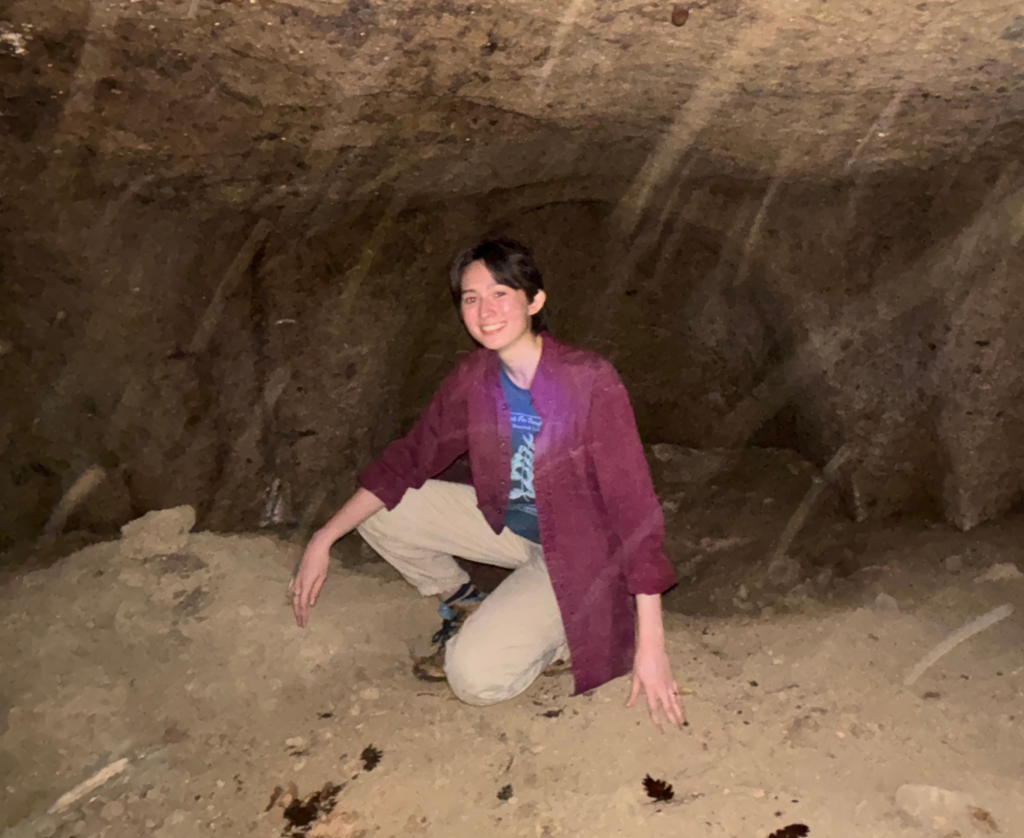
Skye McCord in a tomb at the Valle Gianni Field School dig site in Gradoli, Italy.
Skye McCord remembers becoming fascinated by archaeology by watching as many documentaries and PBS Nova episodes on the subject as possible as a kid growing up in Crystal Lake, Illinois. They joke that it felt natural because they have “nerdy” parents who encouraged them to follow their interests wherever those interests led. When McCord couldn’t find a direct educational path locally to become an archaeologist, they made their own.
McCord took related courses at McHenry County College, and then transferred to NIU where they quickly found faculty members who fueled their passion and offered an unexpected level of support.
Under the guidance of Dana Bardolph, assistant professor of anthropology, and Sinclair Bell, professor of art history, McCord was able to build a schedule of relevant courses and get hands-on experience doing research and field work. McCord was open to tackling new projects and experiences. The end result is that after graduating from NIU this May with a degree in anthropology and a minor in art history, McCord is going to attend Cornell University’s Institute for Archaeology and Material Studies (CIAMS). They received a funded offer from Cornell to pursue a master of arts in archaeology.
Bardolph did post grad work at Cornell and encouraged McCord to consider the program. “Cornell will offer Skye a vibrant intellectual space with programming that includes a colloquium series, a podcast series, conferences and more,” Bardolph said. “I connected Skye with Dr. Verity Platt, who I overlapped with when I was there, and she will be serving as Skye’s M.A. program advisor.”
“I love taking classes with Professor Bardolph,” McCord said. “Her work is focused on American archaeology, so she works in the Midwest and in Peru. Her specialty is on paleobotany, and working with her I’ve learned a lot about plant analysis and botanical remains. It’s interesting stuff, but it’s not quite what I wanted to focus on.”
McCord was drawn to Cornell, in part, because of the different locations they offer fieldwork in.
“They do fascinating interdisciplinary work across all different locations,” McCord said. “They have a particular strength in the Mediterranean, which is why I was so drawn to the program. CIAMS really goes above and beyond in integrating different methodologies in the classical world. It’s cutting-edge archaeological techniques, and I’m very antsy to get a look at some of the lab facilities. At Cornell, I’m going to be focusing on Roman archaeology, and I’m really excited to learn from the large array of researchers and methods that they employ at CIAMS. They run a dig site at Pompeii that I’m very hopeful to get on board with.”
McCord didn’t know they had an interest in art history until their first class at NIU.
“I took a Hellenistic art history course with Professor Bell,” McCord said. “It was my first art history course and the reason I chose that as my minor. He was incredible to work with. I had a million questions. I went to him and told him that region of the world and that time period were what I want to do with archaeology, but I knew our department doesn’t offer that. Luckily, he’s generally an archaeologist by trade, and he supported me right away and put me in touch with incredible researchers.”
McCord said that Bardolph and Bell put in a lot of time helping to organize a study structure and a set of opportunities and experiences to make sure that McCord was getting everything out of their undergraduate studies to be able to go on to pursue the research that they wanted to do.
Bardolph helped connect McCord with Karen Samonds, professor of biological sciences at NIU for their first independent study experience assisting Samonds with cataloging and research for her paleobiology lab studying specimens from prehistoric Madagascar. McCord also worked with Bardolph in her lab doing analysis of plant remains from archaeological sites.
Bardolph is McCord’s senior thesis advisor. She was struck by McCord’s interests in both the research, and the hands-on aspects of archaeology.
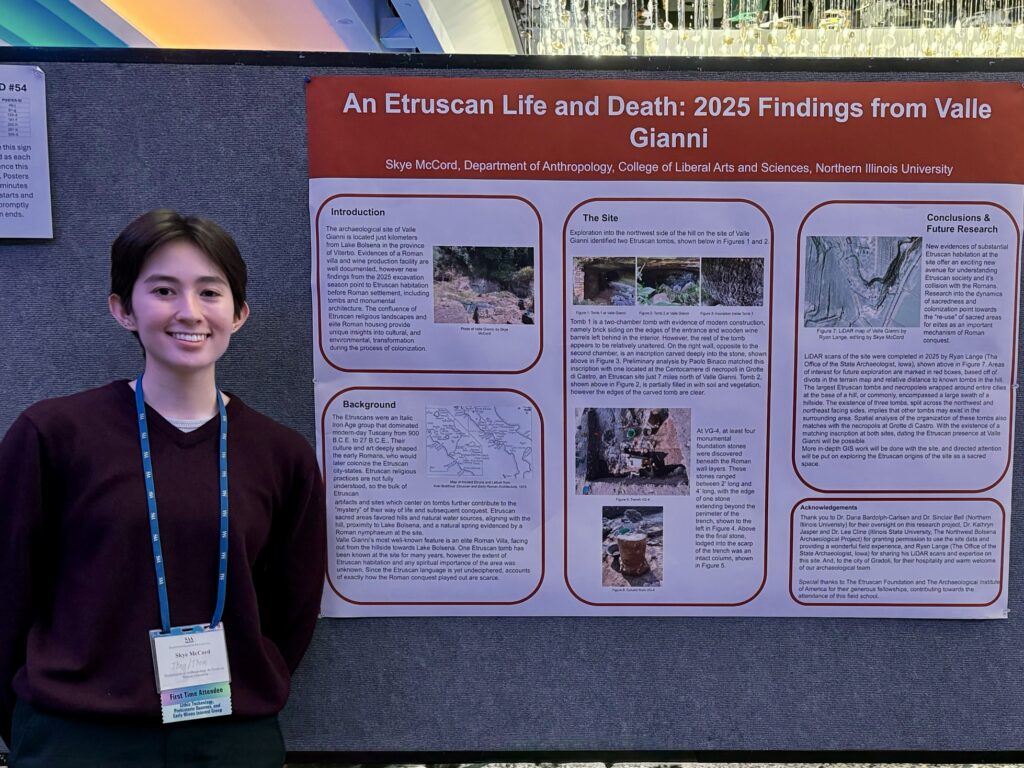
Skye McCord presenting their research poster at the Society for American Archaeology annual meeting in San Francisco, Calif., May 1.
“I think cross-pollinating the ideas between classical archaeology and anthropological archaeology is a rare skill,” Bardolph said. “These disciplines, for better or worse, don’t always talk to each other as much as they should. Skye’s done a great job of bridging them and exploring interests in environmental archaeology. They spend a time in my lab analyzing ancient plant remains and did a great job, but also realized an interest in other types of analysis like landscape analysis. They are willing to get their hands dirty. Skye will do very well with the teamwork required of a field school, and is prepared to excel in the classroom setting at Cornell.”
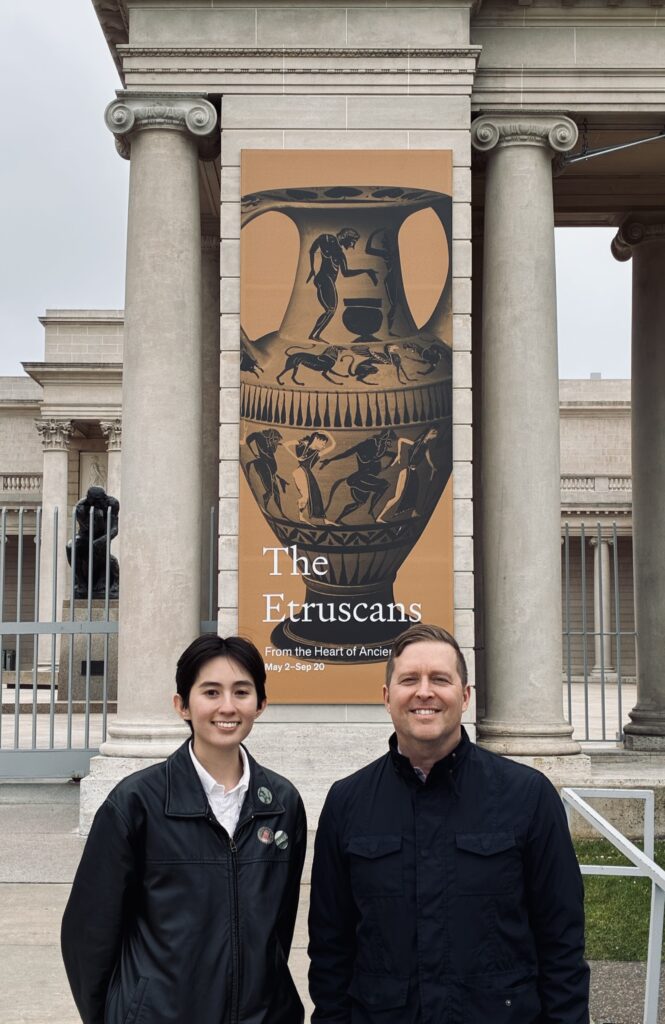
Skye McCord and Sinclair Bell in San Francisco at the Society for American Archaeology annual meeting.
McCord worked with Bell and Bardolph on research projects and outlining their thesis on LiDAR maps (remote sensing mapping method) of Etruscan tombs, from the Valle Gianni field school in Gradoli, Italy. McCord will be returning to Valle Giani this summer as a staff member on their research dig. On May 1, McCord was asked to present a poster on their research at the Society for American Archaeology’s annual meeting in San Francisco.
Bell and Bardolph were able to assist McCord in applying for fieldwork support, and those efforts paid off, as McCord won highly competitive awards from both the Archaeological Institute of America and the Estruscan Foundation.
“Skye is a student, researcher and thinker of high intellectual caliber,” Bell said. “Skye has creative ideas and is cautious and methodical in securing evidence for them. Their written assignments are always carefully composed, demonstrating a sensitivity to nuance and context, and show evidence of a highly original voice. I could always count on Skye to speak in class discussion–even when other students shied away from some of the more contentious issues. Skye is, without a doubt the best undergraduate I have taught or supervised in 20 years of teaching.
“I’ve never seen anyone get the two hardest fieldwork fellowships, much less on their first try. That in itself was mind-blowing.”
McCord is also very appreciative of NIU’s Office of Student Engagement and Experiential Learning (OSEEL). “I worked with them for a few semesters,” they said. “It is really great for undergraduate students to get experience with research, hands-on work and presenting at conferences and it’s really cool to get paid for it.”


