
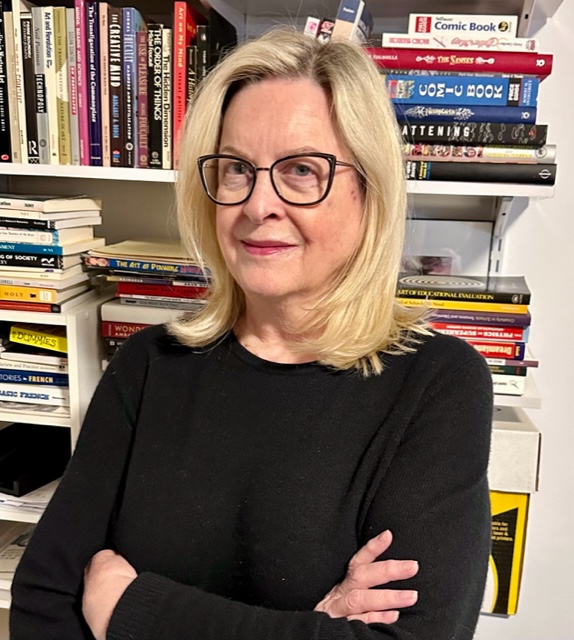
 Dr. Kerry Freedman, professor of art and design education in the NIU School of Art and Design is the 2026 recipient of the National Art Education Association’s Eisner Lifetime Achievement Award.
Freedman has previously been honored by the NAEA with the National Higher Education Art Educator Award (2006), the Manuel Barkan Memorial Award (2012) and the Lowenfeld Award (2018).
Freedman says that the Eisner award holds special significance for her.
“Elliot Eisner was an amazing scholar. He and I had some great public debates,” she joked. “We didn’t always agree, but we were both committed to improving the field. The amazing thing about Elliot was that you could argue with him in a conference session and then go out for a drink afterwards. There are very few people who can do that: have a scholarly debate and not make it personal. It’s one of the reasons I particularly appreciated him.”
The Eisner Lifetime Achievement Award is not awarded annually. It is only given in years when someone is deemed to be worthy of recognition for a lifetime of professional achievement that has advanced art and art education.
Freedman certainly meets that criteria. She is one of the most published art education scholars alive. In 2024, she co-authored “Visual Methods of Inquiry,” and in just the last year, she has published second editions of two of her works, which are among the pre-eminent books in the field, “Curriculum, Culture and Art Education” and “Teaching Visual Culture
Freedman says that her work on visual culture is her most lasting legacy. When she first published Teaching Visual Culture in 2003, there was little language for visual culture in art education.
A 2021 study showed that about 50% of art educators are now teaching visual culture or a cultural emphasis in art education.
“It’s a remarkable shift in one generation,” Freedman said. “So many teachers have worked to update art education for the 21st century. Enabling students to work with traditional art materials is essential, of course, but helping them analyze, critique, and make their own mark on the visual culture ecosystem, has become important as well. So many images and new cultural forms and conditions affect students visually now compared to 20 years ago. It makes sense to address these in art education.”
The second edition of the book includes discussions of artificial intelligence and other topics that were not prevalent 20 years ago.
“I’ve published articles on leadership, curriculum, social justice, and other issues,” Freedman said. “But I think that book is the standout.”
Freedman is quick to point out that while she was at the forefront of identifying the importance of visual culture in art education, she was not alone. Though even then she was literally giving a home to the conversation.
“I had been working on the book and we had a group of about 12 leaders in the field meet to discuss these issues. The meeting happened around our kitchen table,” she said of the St. Charles home she owned with her husband, Dr. Douglas Boughton, who is also a professor of art and design education in the NIU School of Art and Design, and who is also being honored at the 2026 NAEA Convention with the Viktor Lowenfeld Award. “We had a large house in St. Charles (Illinois), for more than 20 years. We had a few conferences in that house, and at that first meeting of the visual culture group, people stayed overnight. We had a dozen people sleeping on beds and couches, cooking together, walking together, and hashing out ideas. We were all people who understood that to only focus on child expression or on historical fine art was not the future of the field. We didn’t want people to think less about kids’ artistic production, but rather to open up art education and incorporate the visual arts outside of fine art. We wanted to help people understand that students live in a visual culture milieu that influences them on a daily basis, which has expanded even more in the last 20 years. That was the new topic of art education.”
Freedman fears that there is a risk of going backwards.
“We’re seeing a bit of retrenchment now back to a focus on process, rather than balancing process and product,” she said. “Perhaps it’s a move away from AI, in part, back to a focus on individual making, just the student and the material. Perhaps a matter of taking refuge in fine art processes. I understand that completely, but that approach will not give students the tools they need to deal with all of the visual culture they encounter. How will a focus on traditional art media processes help them understand deep fake videos and their influence? How can they understand image generating AI if they aren’t taught something about the human-machine relationships that will play such a large role in shaping the future? Students need to become familiar with both image generation AI and traditional materials, in part, so they can set that comparison.”
Freedman’s career as a sought-after expert on topics like this before joining NIU, and in establishing NIU’s PhD in Art and Design Education program, have helped her see the world. As well as being invited to U.S. universities, such as Harvard, she has been invited to lecture and consult in European countries, Canada, Australia, and Asian countries, including visits to the University of Cambridge in England and was given a Fulbright Fellowship that took her to three former Soviet counties. Several of her PhD candidates have answered her question, “What is your main professional goal?” with the answer, “To be you.”
And, she admits she has one more reason to feel affection for the man who this award is named after.
At a conference in 1993, Freedman was working on the first edition of “Curriculum, Culture and Art Education” and was looking to get as many perspectives from around the world as possible. She asked Elliot Eisner if he knew anyone from Australia who would be a good choice to write a chapter.
Eisner told her he knew just the person, and that he was sitting just a few feet away.
He turned and introduced her to the man who would become her husband, Doug Boughton.


