
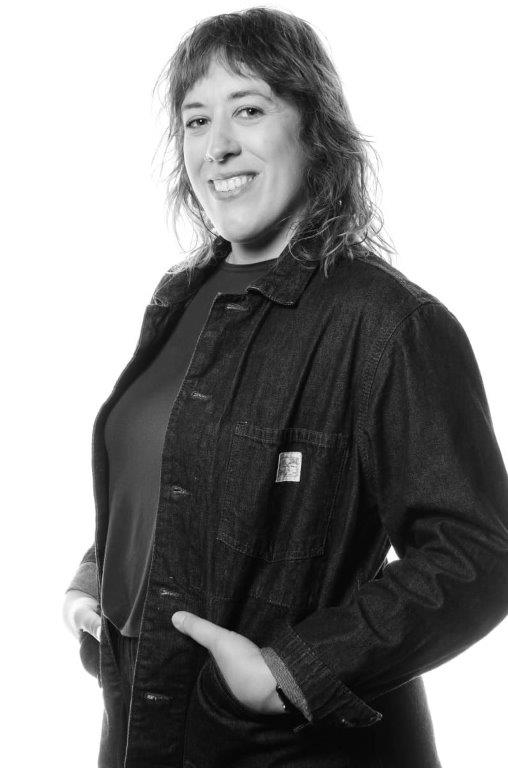
 Adrienne Miller, M.F.A. ’15, came to NIU with a clear goal: to elevate her career.
Now serving as exhibition and publications manager at the Speed Art Museum in Louisville, Kentucky, Miller has built a career where creativity meets precision.
“I was a studio manager and gallery coordinator at Vanderbilt University for five years,” she said. “I kept running into jobs that I was interested in applying for that all required a graduate degree. The time I spent at NIU developing my own studio practice, teaching, and working at the NIU Art Museum led me exactly where I am today.”
After applying to several graduate programs, Miller chose NIU for its strong offer of two graduate assistantships: one as a shop technician in the printmaking studio and another at the NIU Art Museum in Altgeld Hall.
“I applied to NIU knowing I would get to work with Professors Michael Barnes and Ashley Nason, both of whom I had met previously through national printmaking conferences,” she said. “Michael is one of the preeminent American lithographers and has really put NIU on the map as a school to study printmaking.”
Printmaking is a process that involves creating images by transferring ink from a surface—such as metal, wood or stone—onto paper or another material. One printmaking technique, lithography, relies on the repulsion between oil and water to produce detailed, layered prints. Another technique, known as the intaglio process, fascinated Miller from the start.
“The intaglio printing starts by carving lines into a metal plate. Ink settles into those grooves, and paper is pressed into the plate to pull out every detail,” Miller said. “In contrast, I also often worked with relief printing, where the ink sits on a raised surface and the paper picks up the image from the top. I liked to use Japanese paper and also created collographs to mix things up by using textured materials to build the plate, rather than carving or etching.”
Miller’s three years at NIU flew by. She taught courses in printmaking and drawing, gaining valuable experience as an educator. She appreciated having a large off-campus warehouse studio owned by the university to work in and cherished the faculty and students she collaborated with.

Adrienne Miller came to NIU to advance her art career and was welcomed with two graduate assistantships. She shows off a large etching in the NIU printshop. (Photo credit: Adrienne Miller)

Adrienne Miller’s “A Buried Retrieval” is currently featured in the NIU Art Museum’s Sixty Years of Printmaking at NIU: A Legacy of Excellence exhibit. (Photo credit: NIU)
Recently, she attended an NIU event in Kentucky, eager to reconnect with and meet fellow Huskies.
“I had never met any other alumni in this area, so I was curious who would be there,” she said. “It was so lovely reminiscing about DeKalb and the campus.”
At the event, she was also able to share her love of the arts and advocate for others to explore art in the community.
“Supporting art and creativity in your own community is so important,” Miller said. “Go to gallery openings, the theater, or an orchestra performance. You don’t always have to spend money, but if you feel compelled to, museum memberships are a great, lower-cost way to support the arts. Finally, buy artwork that moves you! It doesn’t have to be fancy or expensive; any purchase allows the artist to keep making things.”
Miller’s passion is reflected in her work at the Speed Art Museum, where she plays a role in managing every exhibition and installation. At any given time, she might be drafting contracts for shows years in the future while overseeing a current installation.
“I like to describe my role as being the air traffic controller for six curators and their projects,” she said. “Whenever we create a publication in-house, I work alongside our curators and designers to ensure the project is completed on time. It’s a unique role that requires both high-level strategic thinking and attention to the smallest details.”
Founded in 1927 by Hattie Bishop Speed in memory of her late husband, the museum is the largest and oldest art museum in Kentucky, housing over 13,000 objects. It will celebrate its centennial in 2027.
“My favorite part of my job is designing exhibitions,” Miller said. “It’s somewhat like being an interior designer. You have to consider both the content of the artwork and how the space helps visitors understand the conceptual takeaways.”
Before stepping into her current role, Miller honed her skills through a series of positions at the Speed Art Museum, including exhibition and special project coordinator and assistant preparator. She also freelanced for local museums and art organizations, building a diverse portfolio of experience.
“I have been very strategic and sometimes lucky with the roles I have taken on through my career,” Miller said. “I was pushed as early as high school to volunteer or intern with other creatives and find out what jobs as an artist might look like.”

“Untitled, mixed paper, chine colle, gouache and monotype, 2020, 11”x15” artwork by Adrienne Miller. (Photo credit: Adrienne Miller)
Outside of her museum work, Miller is also a practicing studio artist. She primarily works two-dimensionally on paper, focusing on printmaking. She describes her studio practice as exploring symbolic landscape and abstract architectural spaces to examine the psychological power of physical and mental boundaries.
“My personal research involves psychology, America’s relationship to natural spaces, suburban expansion, and the history of property ownership,” she said. “Lately I have been studying female surrealist painters active during and after the World Wars, thinking about the dynamic relationship of their work to the cultural and political change that was happening around them.”
This year, in addition to working at the museum, Miller and her husband opened a small gallery in Louisville called Friend of Mine, housed in their storefront studio building. Between exhibitions featuring other artists, Miller’s own work is often on display. She also has art currently featured in “Sixty Years of Printmaking at NIU: A Legacy of Excellence” in the NIU Art Museum.
When asked what contributes to her success, Miller credits focus, community engagement and hard work. She acknowledges her parents for exposing her to diverse experiences and the arts at a young age.
“I grew up in Memphis, Tennessee, and I was always involved in extracurriculars and community service,” she said. “Reading, creativity, theater, music—those things were always emphasized around me. That early exposure shaped how I see the world today.”
Miller is also quick to acknowledge inspiring teachers and mentors who helped her stay the course. She worked closely with NIU Art Museum assistant director Peter Olson, describing him as a calm and steady presence who consistently offered thoughtful, grounded advice.
“Anytime you can build a rapport with someone who sees your genuine interest and wants to help you grow, that’s a special relationship,” she said


