

This article originally appeared in a 2014 edition of Northern Now.
by Mark McGowan
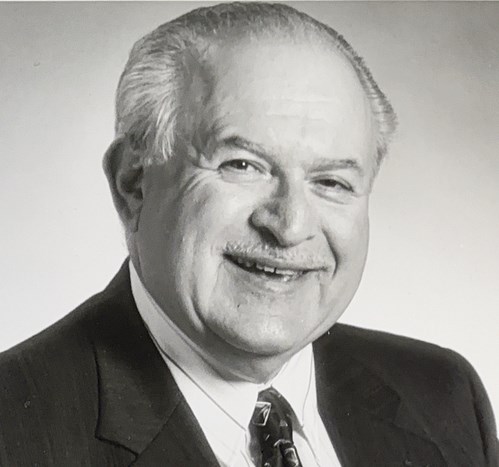
Ron Modell, Professor Emeritus, NIU School of Music
They called it “Jazz Alley” – four swingin’ groups from the NIU School of Music, stationed throughout the main floor of the Holmes Student Center, jamming for the passersby.
Part of the “Big Bold Event,” it was the culmination of months of conversation on the university’s future – a grand unveiling of brainstorms on improving the student experience, one goal of which is to make NIU a cool place.
Hundreds who had gathered April 24 in the Duke Ellington Ballroom paraded behind President Doug Baker and the luring street beat of snare drummer Everett Benton Jr., a member of the Dixieland-loving NIU Higher Learning Brass Band.
Ron Walters, NIU’s strategic initiatives adviser, had been talking up the Jazz Alley for weeks, telling participants in the “Bold Futures” workshops that he knows good jazz – he’s on the advisory board of the Lionel Hampton Jazz Festival – and that NIU has great jazz.
That wasn’t always the case.
Ron Modell stands in the doorway of his home, scanning the meager traffic on his quiet street.
His modest ranch, pale yellow with white trim and a one-car garage, is on the south side of DeKalb. As he and his wife have just returned from a winter in Florida, tiny Christmas lights still lay atop the shrubs even though it’s May. A wooden post near the cement front porch informs visitors that grandchildren are spoiled there.
A brief pass through the living room into the kitchen disproves what one might expect of an aging music legend’s house. There is no piano. No framed, autographed black-and-white photos on the wall. No stereo surrounded by stacks of CDs, tapes and records.
Pushing 80, and blessed with a picture-perfect memory for names, faces, dates and conversations from his time on earth, Modell seems to have no need of such museum pieces – although a collage of his famed photos and original paintings of album covers are stored in the basement.
Forty-five years after NIU hired him to teach classical trumpet and create a jazz program from scratch – one he nurtured from nothing to national acclaim within eight years – he remains a man who loves to talk. Stories tumble out of him like popcorn bursts from the kettle at a movie theater. He drops names like trees shed leaves in October. He prefaces many tales this way: “You’re not going to believe this.”
It isn’t always easy to score all-purpose quotes from him. “Great question,” he often responds. “Let me tell you a story.”
But any time spent with Modell, who still possesses the velvety Bronx inflection heard during so many NIU Jazz Ensemble concerts and recordings, is a trip worth taking – and a journey worth reading in the maestro’s newly published memoirs.
Modell unexpectedly reaches for the cordless phone placed on his kitchen table. It’s a landline that requires direct dialing, not a cell with pre-programmed contacts.
He swiftly inputs a number from memory.
Suddenly, an answer – no, a voicemail – and the wail of a saxophone. Blue Lou Marini’s voicemail. Blue Lou Marini, the long-haired saxophonist from “The Blues Brothers” movies and Steve Martin’s “King Tut” band.
“Marini!” Modell crows after the beep, not identifying himself before shifting to small talk about Marini’s latest tour. Modell really doesn’t have much to say, just that he’s got some new jokes to tell.
“Give ‘The Mode’ a call,” he finishes, hanging up as casually as if he’d called out for pizza.
Modell had already created a “stage band” at Southern Methodist University in Texas before arriving at the jazzless NIU in 1969.
Sixty Huskies auditioned that first fall for the 20 chairs available.
For the next three decades, that process proved “so grueling and so emotionally straining,” he says. “The first week of school every semester, I earned 80 percent of my salary for the year. The first week was auditions; the same excerpts of music, over and over again.”
Many hopefuls were top dogs at their high schools, he adds, but NIU dramatically raised the stakes. “To the students who had come to NIU with the dream of playing for the NIU Jazz Ensemble, it was the look on their faces: ‘Is there a place for me? Can I make it here?’ ”
In October of 1969, only six weeks after launch, the NIU Jazz Ensemble played its first concert.
Following advice from Leon Breeden, director of jazz studies at North Texas State University, Modell had quickly laid the foundation for what would become an institution.
“Leon told me my program would not reach its apex until half of each concert contained student compositions and arrangements,” he says.
Students were encouraged to write their own original music or arrange music they really loved for big band. Modell insisted they conduct not only the live performances but the recordings if their works were selected.
Meanwhile, they gained good experience for classroom careers by teaching and conducting while adding those recorded performances to their resume packages strongly bolstered their credentials.
The boss didn’t love everything he heard, though. “Once in a while,” he says, “a student would come in having written something really far out, really avant-garde.”
Those would-be composers heard a joke about the two Viennese scientists, one of whom cheers that he’s found a new way to make a baby. What a shame, the other replies; the old way was so much fun. “They immediately got the message,” Modell says. “Go home and fix it.”
He also insisted that students never pay one penny to represent NIU with their time and talent as members of the nation’s No. 1 touring jazz ensemble.
In the early years, that wasn’t easy. Budgets were small – so tight that the NIU Student Association paid for sound equipment and an electric piano – and he usually charged venues “just enough to cover expenses.”
It’s the summer of 1977, and Modell and his family are driving through Wyoming to Yellowstone. They stop for gasoline – this is when “full service station” employees still filled the tanks – and Modell climbs out of the station wagon to stretch his legs.
The young woman holding the pump smiles and points at him. She begins to wave her arms like a band conductor.
Only one year later, and less than a decade after the day he planted the first seed, Modell and the NIU Jazz Ensemble join Dizzy Gillespie as the featured performers at the National Association of Jazz Educators annual conference in Dallas. Every music teacher in the audience poses the same question afterward, Modell says.
“Where the hell is DeKalb, Illinois?”
NIU has arrived.

Louis Armstrong, Ron Modell
Modell appeared on the Studs Terkel Show with jazz drummer Louis Bellson in 1979; a producer from WTTW-Chicago called the next morning.
His name was Michael Hirsh, and he wanted to create a public television documentary on the NIU Jazz Ensemble. Modell said yes.
Four years later, “A Year in the Life of the Greatest College Jazz Band in America” flooded the national PBS airwaves. Fan mail from as far away as Alaska and Hawaii arrived in DeKalb. The documentary won two Chicago Emmy awards.
Proclaimed the top college jazz band in the country in 1983 by Downbeat magazine, Modell and Co. conquered Europe that July with an appearance at the world-famous Montreux Jazz Festival in Switzerland. The live recording from that gig was released in 1984.
Three of the six NIU presidents during Modell’s time said the same words to the press: The jazz ensemble and its international adoration cultivated the university’s greatest public relations.
Eddie Williams, NIU’s longtime and now retired vice president of Finance and Planning, was equally as effusive in a letter to Modell, writing, “You have made us a world-class university.”
“This was my job,” Modell says now, 30 years later. “I never dreamed what extraordinary things might happen.”
By the end, the ensemble was earning thousands of dollars for its professional performances, money invested back into operations and a nest egg for Modell’s successor, Ron Carter.
Ask Modell where the magic came from, and for the only time in a two-hour interview, he stops to think. He wants to answer carefully.
First, he says, he always told the band to “go out there and have fun tonight.” Second: the student compositions and arrangements. Third: the rapport that developed between him, the band and the audience.
Lastly, he says, was “the certain pride that built up over the first few years.”
“When we welcomed a new member, we said, ‘You have to check your ego at the door.’ Our goal was to aspire to the highest level of music-making,” he says.
“Dick Judson, an orchestra leader in Chicago, was overheard remarking, ‘I never hesitate hiring any musician who had gone through Ron Modell’s NIU Jazz Ensemble. I know they will be prompt, well-dressed, no drugs, no alcohol, and that their playing will be on a high level.”
He views his teaching as paying it forward; mail from alumni – notes that make him “cry like a baby” – offer such confirmation. “How much more of a reward could I have,” he says, “than to receive letters – many, many, many, many letters – that say, ‘I find myself teaching my class and instilling the same values you instilled in me during my time at NIU.’ ”
The 28 years Modell spent at NIU represent just a little more than a third of his life.
Born in 1934 to Nathan, an NYC cabbie, and Gertie, a homemaker, the second of three sons became a professional musician at 15, embarked on his first national tour at age 18, was named principal trumpet of the Tulsa Philharmonic Orchestra that same year and eventually played nine seasons with the Dallas Symphony Orchestra as its principal trumpet.
Modell performed everywhere from Catskills supper clubs to Carnegie Hall, met Hollywood movie stars on Paramount Studios soundstages and shook the hand of President Lyndon B. Johnson in the White House.
He channeled his love of baseball into umpiring, starting with the little leagues and ascending to the collegiate level, including NIU Huskies games.
After retirement in May of 1997, he embarked on an international expedition of lectures and demonstrations for the United Musical Instrument Co. He visited colleges and high schools and, in many cases, stayed a second day to perform as a soloist with the school’s jazz band or symphonic group.
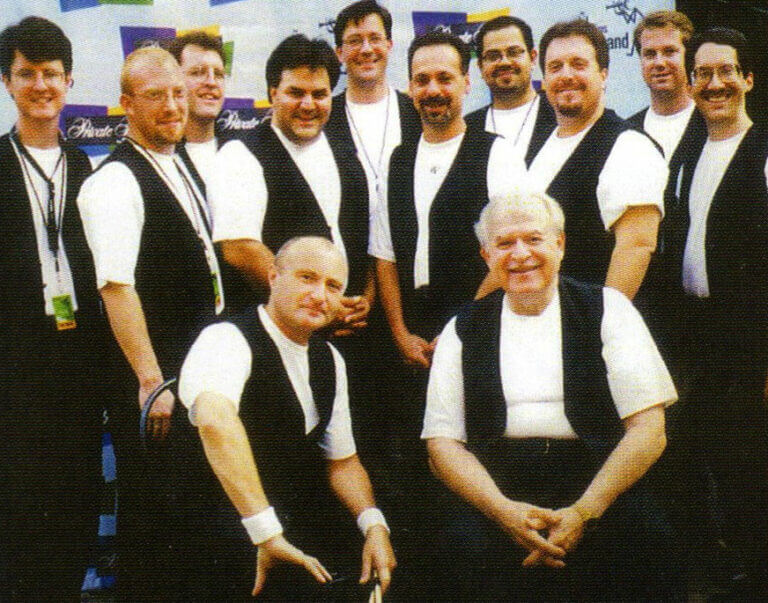
Front row: Phil Collins, Ron Modell, back row, NIU Jazz ensemble alumni
In 1998, at the request of Phil Collins, he assembled a band that included nine alumni of the NIU Jazz Ensemble for the pop star’s worldwide summer tour.
When Modell and his wife, Kathy, became snowbirds in Bradenton, Fla., he took up golf – Kathy’s passion – and even stand-up comedy, appearing regularly at McCurdy’s Comedy Theater in Sarasota.
Shortly after 9 p.m. July 4, 2007, at the end of his 38th consecutive Independence Day concert as soloist with the DeKalb Municipal Band, the 72-year-old packed his trumpet for the final time. Unwilling “to go even a fraction below” the level of technical and musical virtuosity he had always maintained, he has not played one note since.
Prompted by a remark from Kathy, he began to write his memoirs.
“She told me, ‘You cannot leave this earth without documenting the incredible stuff that has happened during your lifetime. If no one but us and the kids reads it, it’ll still be worth it.’ ”
Quincy Jones contributed the book’s forward. This is a short excerpt.
“Really, the book is a love story. It’s about the love of music, but also of people in general. Ron just naturally generates so much positive energy and good will that people just can’t help giving it back. And his notorious sense of humor – humor a la Mode – was an asset in his dealings with everyone. He just makes people around him feel better. And that enthusiasm, that love, that energy bounces back and forth between him and the musicians – and among the musicians, too. You can hear it in the music.”
Titled “Loved Bein’ Here With You,” adapted from the tune Modell sang to close every jazz ensemble concert, the book is a page-turner full of humor and heartbreak, wit and wisdom.
His voice in print is wonderfully conversational, familiar and direct.
Available online through www.amazon.com as an e-book or in paperback, Modell’s autobiography provides backstage stories from his childhood trumpet lessons as well as club gigs, symphonic rehearsals, formal orchestral concerts and NIU Jazz Ensemble shows at secondary schools across the Midwest and the state prison in Pontiac.
It offers peeks at conductors and musical stars, both humble and pompous. It reveals some of Modell’s early-years compensation and, in one hilarious anecdote, a salary negotiation.
He reprints letters he received from alums and legends. He spins jokes he’s told and jokes he’s heard. He offers instruction on practicing instruments, teaching students, resolving conflict and triumphing in life.
And, nearly two decades after he bid farewell to NIU, he shows that his time here presciently filled President Baker’s current prescription for student career success and mentorship.
Modell’s young squires taught each other, played countless gigs, composed and arranged music and made recordings they could package with their resumes. Meanwhile, the NIU Jazz Ensemble always toured with established pros, sharing not only the stage but the bus.
He hopes his vivid recollections offer smiles to all.
“The book should bring back some very, very fond memories of going to the Duke Ellington Ballroom twice a year. We always attracted 2,000-plus people,” Modell says. “Those nights were some of my greatest thrills


