
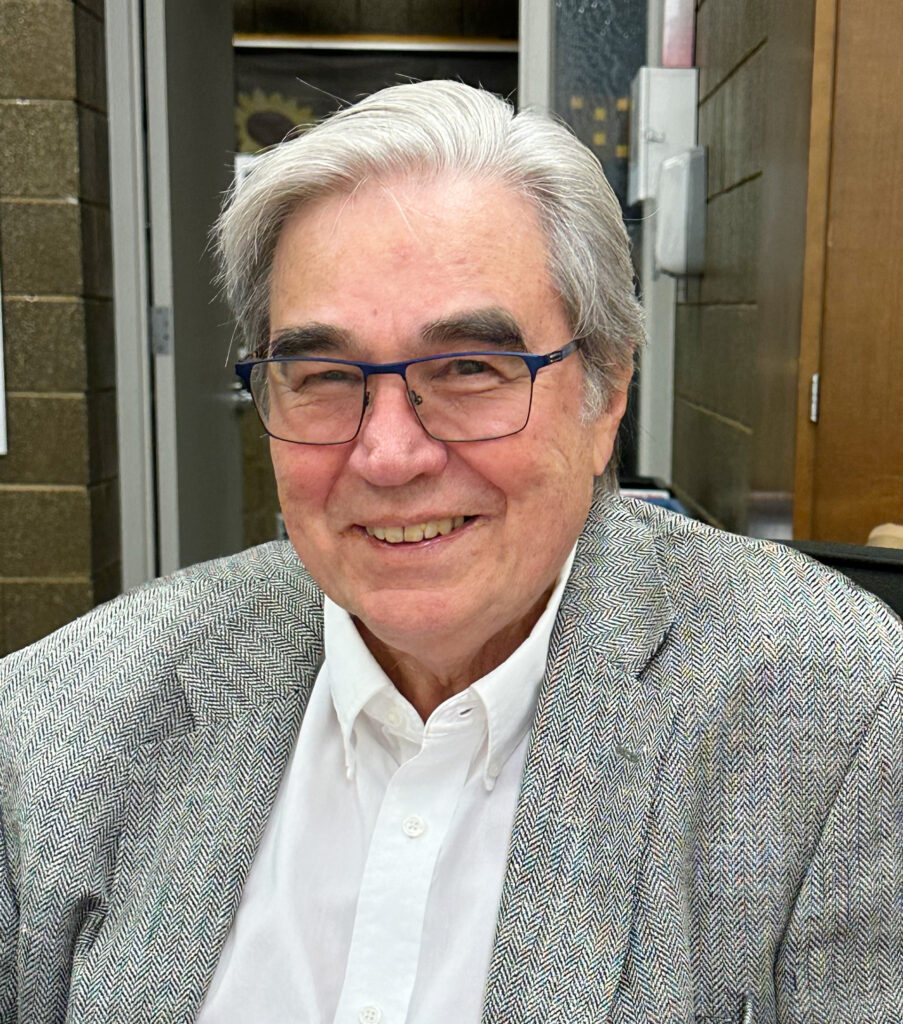
 Douglas Boughton, professor of art and design education in the NIU School of Art and Design has won just about every major award in his field, and that now includes the Viktor Lowenfeld Award from the National Art Education Association.
Boughton’s career as an art educator spans more than 60 years. His work has been published on five continents in at least nine languages, and he has given keynotes, workshops or invited lectures in more than 30 countries, including Greece, Finland, The Netherlands, Australia, Turkey, United Kingdom, Crete, Taiwan, New Zealand, Japan, South Korea, Germany, Portugal, Hong Kong, China, Estonia, Chile, Brazil, Singapore, Italy and Fiji, just to name more than a few.
He owes much of his travel to becoming World President of the International Society for Education through Art (InSEA) and chief Examiner of Visual Arts for the International Baccalaureate Organization, a program recognized in more than 100 countries. Boughton was responsible to ensure an equality to the standards in each country where the IB program existed.
When asked why he chose to teach art, he jokes, “Why not teach art? I loved to draw and paint and was fairly good at it. In fact, my father may have had an impact on my choice. When I was about 12 he said, ‘Doug, I don’t know what you’re going to do when you leave school. You’re always drawing stuff, so maybe you could teach that.’”
It turned out to be a very good idea. The man who has been teaching art for more than six decades attended a school without an art teacher, and had to have the initiative to seek out an opportunity on his own to study it remotely. “I grew up in a little country town,” he said. “We had no art teacher, but I took it by correspondence with a school in Sydney. I had to do everything by mail. I learned art history by studying little two inch by two inch black and white reproductions, because the correspondence school didn’t have sufficient budget in those days to send out pictures of artworks in color.”
He has been a full-time professor in the United States, Canada and Australia and has taught every level from preschool kids to doctoral students. His teaching career started at the age of just 19 in his native Australia.
“It was the 1950s,” he said. “There was no year 12 in the Australian school system, so I finished year 11 and the teacher training program I took was only two years long, so just about a week after my 19th birthday, I was in front of my first class. Forty-four grade four boys. It was fun, but I couldn’t imagine teaching elementary school forever, not because I didn’t enjoy it, but I couldn’t see myself doing it for the rest of my life.”
So, Boughton enrolled in a teacher education program at the art school in Sydney, Australia, attending classes four nights a week plus Saturdays for four years to complete the “Art Teacher Conversion Course” qualifying him to teach high school art. Three years later he took an in-service training appointment as a touring art advisor, responsible for 308 schools covering nearly a quarter of a million miles in the outback of Australia’s New South Wales.
After receiving his diploma of Secondary Art Education from the National Art School in Syndey, he left Australia for Canada to continue his education. He earned both his bachelor of education in art education and a master of arts in art education from the University of Calgary, and then his Ph.D. in secondary art education from the University of Alberta.
He came to NIU in 2000 to help create the Ph.D. program in art and design education. Since completing his PhD he has pursued his keen interest in developing better ways to assess student learning in art.
“School administrators tend to think the easiest way to show what a student has learned is to represent that learning with to a few numbers,” he said. “Measurement is easier, but not more appropriate. Assessing art learning is difficult and complicated. How do we know when students have learned? Instead of measuring student performance through some sort of test, it is a much more valid approach for teachers to make a judgement about the qualities that are evident in their art, and to look at students’ portfolio of work, which is by its nature personal and reflective and most importantly provides an insight into the intellectual footprints of their creative growth.”
Boughton has won just about every art education educator award that can be won. He has been named the Higher Education Art Educator of the Year at both the state level (Illinois Art Education Association) and nationally (National Art Education Association). He won the Edwin Ziegfeld Award for his outstanding contribution to international art education. He was named Distinguished Visiting Professor by East China University in Shanghai. He is chair of the Distinguished Fellows of the NAEA.
And now, he’s the winner of NAEA’s Lowenfeld Award.
The award is named in honor of Viktor Lowenfeld, who, as professor of art education at Penn State University was credited with helping to “define and develop the field of art education in the United States.”
Lowenfeld was born in Austria in 1903 and taught art in elementary schools while attending the Vienna Academy of Fine Arts. He fled Austria in the run up to World War II and was aided in that effort by art educators who first helped him get to Italy and then, on to England where he received assistance from Herbert Read, a prominent philosopher who was a key factor in the development of art education there.
Lowenfeld eventually made his way to the United States and taught psychology at Virginia’s Hampton College, one of the first African-American colleges in the country. At Hampton, several of his students became prominent artists, including John Biggers, Elizabeth Catlett and Samella Lewis.
In 1946, Lowenfeld moved on to Penn State where he establish the first doctoral program in art education. Penn State is now one of the largest art education programs in the nation, part of a group that includes NIU, Ohio State, Florida State, and University of Arizona.
Lowenfeld’s writings continue to have an impact on art education. In 1947 he published Creative and Mental Growth which became the most used text in courses for students studying to become elementary school art teachers. Now in its eighth edition, Creative and Mental Growth continues to be used today. The award in his name is given to a scholar who has built upon and expanded his work.


